




Nightmare of Decay Overview
You are inside a nightmare. The castle knows you're here.
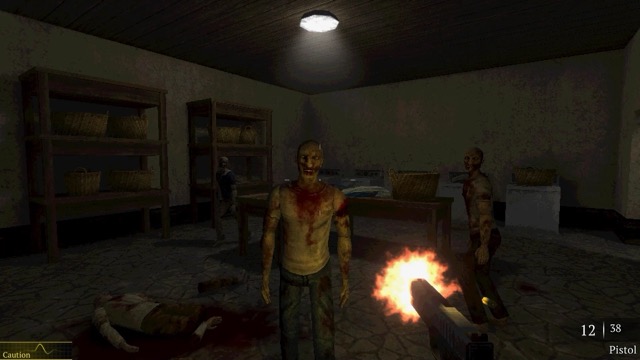
Nightmare of Decay is a first-person survival horror game that abandons the passive evasion mechanics of most horror titles in favor of something bloodier and more direct: weapons, combat, and a castle full of monsters that need to be dealt with rather than hidden from. Rendered in a deliberately retro PlayStation-era visual style on a full 3D engine, the game's aesthetic sits in the particular uncanny valley between old-school horror games and modern design — familiar enough to trigger nostalgia, strange enough to feel deeply wrong.
The castle you're trapped in is not a fixed, explorable space with a clear solution — it is a living nightmare environment, inhabited by monsters, undead, and entities that follow their own irrational logic. Some want things from you. Some want to destroy you. One just wants to talk, and that's somehow the most unsettling of all. The Monster in the Pit collects heads and will bargain. The Black Cat knows you're trapped and offers no comfort. The Lord of Nightmare built this place and built it for you specifically.
Three game modes give Nightmare of Decay a breadth unusual for the horror genre. Campaign mode delivers the full castle exploration experience — combat, puzzles, collected items, and a path toward escape. Troop mode drops you into a limited arena for wave-based monster combat survival. Dungeon mode is an endless descent, with weapon collection and leveling extending your run as long as skill and nerve allow. Each mode uses the same core weapons and combat systems to deliver a fundamentally different horror experience.
For players who want their horror games to fight back.
Key Details
| Genre | First-Person Horror / Survival Combat |
| Difficulty Level | Hard |
| Average Play Time | 30–60 minutes (Campaign); open-ended (Troop and Dungeon) |
| Best For | Horror fans who prefer combat over evasion, retro-aesthetic horror players, and anyone who wants multiple horror experience formats from a single game |
How to Play Nightmare of Decay
Getting Started
- Choose your game mode — select between Campaign, Troop, and Dungeon before entering the castle. Campaign delivers the narrative exploration experience; Troop and Dungeon are combat-focused survival modes. Each plays differently enough that your choice shapes the entire session. New players should try Campaign first to learn the castle's systems and characters before the pressure of wave-based modes.
- Arm yourself immediately — weapons are your primary survival tool in every mode. Locate and equip the available weapon options as early in each session as possible. In Dungeon mode, weapon collection is ongoing; in Campaign and Troop modes, your starting armament sets the tone for the opening encounters.
- Engage enemies rather than avoiding them — unlike evasion-focused horror games, Nightmare of Decay is built around combat. Monsters should be fought, not fled. Learn how each enemy type moves and attacks in early encounters so you can engage subsequent appearances with established tactics rather than improvised responses.
- Collect items and observe the environment in Campaign mode — puzzle elements, hints, and path-forward items are distributed throughout the castle in Campaign mode. Search rooms and corridors thoroughly between combat encounters to build your inventory and gather the context needed to solve the castle's puzzles.
- Interact with the Black Cat when encountered — the Black Cat is the only entity in the castle willing to communicate with you and the primary source of narrative information. Its conversations provide context about the Nightmare, the Lord who built it, and the nature of your imprisonment that the combat and exploration alone don't deliver.
Basic Controls
| Input | Action |
|---|---|
| WASD / Arrow Keys | Move through the castle |
| Mouse | Look around / aim |
| Left Mouse Button | Attack / fire weapon |
| Right Mouse Button | Aim / secondary weapon action |
| E | Interact with objects and characters |
| 1–4 / Scroll Wheel | Switch between available weapons |
| R | Reload |
| Shift | Sprint |
| Space | Jump |
| ESC / Tab | Pause / access menu |
Objective
Campaign Mode: Explore the nightmare castle, fighting through its monster and undead inhabitants, solving puzzles with collected items and hints, and finding the path to escape while confronting the Lord of Nightmare in a final encounter.
Troop Mode: Survive as long as possible against waves of monsters in a limited arena, using all available weapons and tools to endure each successive wave.
Dungeon Mode: Descend through an endless dungeon of escalating monster waves, collecting weapons and leveling up to extend your survival run as far as skill allows.
Nightmare of Decay Features & Highlights
- Three distinct game modes — Campaign, Troop, and Dungeon each use the same combat systems to deliver fundamentally different horror experiences: narrative exploration, arena survival, and endless descent respectively
- Combat-forward horror design — weapons and active engagement replace the passive evasion typical of the horror genre, creating a horror game that demands offensive skill alongside the usual survival instincts
- PlayStation-era retro aesthetic on a 3D engine — a deliberate visual style that occupies the uncanny space between nostalgic horror game aesthetics and modern design, rendering the nightmare castle in a distinctly unsettling visual register
- Morally complex NPC interactions — the Monster in the Pit offers a head-collection bargain with genuine rewards; the Black Cat delivers narrative information without comfort or assistance; the Lord of Nightmare is the final reckoning
- Dungeon mode progression system — weapon collection and character leveling in Dungeon mode create an ongoing power scaling loop that rewards extended survival with the tools to survive even longer
Nightmare of Decay Tips & Strategies
Beginner Tips
- Learn enemy attack patterns in Campaign before entering Troop or Dungeon modes. Campaign's exploration pacing gives you natural breaks between encounters to learn how each monster type moves and attacks. This knowledge transfers directly to Troop and Dungeon modes, where the same enemies arrive in higher volume with less recovery time. Using Campaign as your enemy behavioral school makes the wave-based modes significantly more approachable.
- Manage your weapon ammunition across encounters, not just during them. Reloading after each combat encounter — rather than waiting until mid-fight — ensures you never enter a new engagement with a partially loaded weapon. The castle does not give you comfortable reload windows during active combat.
- Accept the Monster in the Pit's bargain only after considering the cost. The Monster's offer — deliver three heads in exchange for worthwhile rewards — is a genuine gameplay transaction with real implications for how you approach certain encounters in Campaign mode. Understand what you're agreeing to before committing to the collection task.
Advanced Strategies
- In Dungeon mode, prioritize weapon upgrades that address your current wave's threats. As dungeon waves escalate, the enemy composition shifts in ways that make certain weapon types more or less effective. Leveling up and collecting weapons that counter the specific threats in your current wave tier is more efficient than upgrading a preferred weapon regardless of enemy type.
- Use the castle's geometry to funnel enemies in Campaign and Troop modes. Corridors, doorways, and architectural chokepoints in the castle environment limit how many enemies can reach you simultaneously. Positioning yourself at narrow passage entrances rather than standing in open rooms reduces the multi-directional attack surface that makes large monster groups dangerous.
What to Watch Out For
- Overextending in Campaign mode while exploring. The puzzle and item collection objectives in Campaign encourage thorough exploration, but moving too far into uncleared areas without sufficient health or ammunition creates situations where retreat becomes as dangerous as continuing. Clear enemies from an area before searching it thoroughly rather than exploring past active threats.
- Ignoring the Black Cat in favor of purely mechanical progress. The Black Cat provides the only voluntarily shared narrative context in the game — the monsters and undead don't explain themselves. Players who bypass the Cat's dialogue in the interest of combat efficiency miss the story framework that gives the Lord of Nightmare's final encounter its full weight.
Nightmare of Decay Elements Explained
Three Game Modes
Nightmare of Decay's three game modes share a combat system and a castle aesthetic but deliver structurally different experiences that suit different player priorities and playstyle preferences.
Campaign mode is the game's full narrative experience — a linear progression through the nightmare castle that combines exploration, puzzle-solving, item collection, and escalating combat encounters into a directed arc from imprisonment to final confrontation with the Lord of Nightmare. It is the mode that introduces the castle's characters, establishes the nature of the Nightmare, and delivers the game's story through exploration and the Black Cat's dialogue. Campaign is the recommended entry point for new players and the only mode that contextualizes why the castle and its inhabitants exist.
Troop mode isolates the combat system into an arena survival format. A limited space, escalating monster waves, and all available weapons create a focused test of combat skill without the exploration and puzzle-solving demands of Campaign mode. It is the mode for players who want the game's combat depth without narrative pacing, and it scales in difficulty across waves in ways that reveal the combat system's ceiling.
Dungeon mode is the game's endless endurance format — a descending dungeon of progressively harder monster waves where weapon collection and character leveling are the only tools for extending survival. Unlike Troop mode's fixed arena, Dungeon mode's progression system creates a run-based structure where each descent teaches the game's systems more fully, and the power ceiling scales with how far survival extends.
Character & NPC System
Three notable non-combat characters define the narrative texture of Nightmare of Decay, each representing a different relationship to the castle's horror and to the player's situation within it.
The Monster in the Pit is the game's moral transaction character — a strange beast in the castle's deepest space that wants something specific (three female heads, collected from the castle's inhabitants) and offers something worthwhile in return. Engaging with this character requires the player to weigh the reward against the nature of the task, making it the game's most explicit moral complication. The bargain can be accepted, pursued, and completed as a genuine gameplay objective with mechanical consequences.
The Black Cat is the game's sole source of voluntary narrative information — the only entity in the castle willing to communicate with the player about the nature of the Nightmare and what survival actually requires. It is not helpful in any practical sense: it will not assist with combat, puzzle-solving, or navigation. But it will tell the truth about where you are and what the Lord of Nightmare has built, which is a different and arguably more valuable form of assistance. The Black Cat's conversations are the primary mechanism for understanding why the castle exists.
The Lord of Nightmare is the final confrontation and the reason the castle exists at all — a tall figure in a black cloak carrying a long sword, whose development of the Nightmare and capture of its victims is what Slavik and everyone else in the castle is a consequence of. The final encounter with the Lord of Nightmare is the culmination of Campaign mode and the context for everything the Black Cat has been describing.
Combat & Weapon System
Combat in Nightmare of Decay is the game's primary mechanical language — the system through which all three modes are experienced and the skill set that determines survival across Campaign, Troop, and Dungeon alike. Unlike horror games built around evasion and resource conservation, this game demands offensive engagement: monsters should be fought and defeated rather than avoided, and weapon proficiency is the core player competency the game develops.
The weapon roster covers different combat ranges and use cases — close-quarters weapons for the castle's corridors and rooms, ranged options for engagements where distance management matters, and potentially specialized tools for specific enemy types encountered across modes. Switching between weapons fluidly during encounters, matching weapon choice to the specific engagement geometry, and maintaining ammunition discipline across the full session are the habits that separate consistent survivors from players who run out of resources at the wrong moment.
Dungeon mode introduces a leveling component that allows weapon power to scale with survival progression — a mechanic that makes extended dungeon runs not just harder but also more powerful, creating the run-based feedback loop where each attempt teaches the game's systems while also making subsequent attempts more capable. The leveling system in Dungeon mode is absent from Campaign and Troop, keeping those modes grounded in the weapon loadout available rather than a scaling power curve.
Nightmare of Decay Frequently Asked Questions
Q: How do I complete the Monster in the Pit's bargain?
A: The Monster in the Pit requests three heads collected from specific targets within the castle. Identify and defeat the relevant targets during your Campaign mode exploration, collect the heads as items, and return to the Monster's location in the castle's deepest area to complete the exchange. The rewards provided in return are available once all three heads have been delivered. Consider whether completing the task fits your current resource and health situation before committing to the collection objective.
Q: What should I do when overwhelmed by multiple enemies simultaneously?
A: Move immediately toward the nearest architectural chokepoint — a doorway, corridor, or narrow passage — that limits the number of enemies able to reach you from multiple directions simultaneously. Fight from the chokepoint rather than in open space where the full group can surround you. If the current weapon is ineffective against the enemy type you're facing, switch during movement to your closest-range option for the confined engagement. In Troop and Dungeon modes, identify the highest-threat enemy in the wave and prioritize eliminating it before addressing the lower-priority targets.
Q: Is this game compatible with all browsers and devices?
A: Nightmare of Decay is designed for modern desktop browsers, with best performance on up-to-date Chrome or Firefox on a desktop or laptop. The game uses keyboard and mouse controls for movement, aiming, and combat — making touchscreen and mobile devices unsuitable for the full experience. The combat system requires precise mouse aiming and keyboard responsiveness, so stable hardware is recommended over older or lower-performance systems.
Q: Can I save progress in Campaign mode?
A: Campaign mode progress may be saved at checkpoints or significant story moments. Check the pause menu (ESC or Tab) for available save options before exiting a session. Dungeon and Troop modes are session-based formats where each run begins from the start — progress in these modes is measured by how far survival extends rather than through a persistent save state. Completing Campaign checkpoint sections fully before exiting is advisable to avoid replaying resolved areas.
Q: What does the Black Cat actually tell you, and is it worth stopping to listen?
A: The Black Cat is the game's primary narrative source — it explains the nature of the Nightmare, confirms that escape is genuinely possible but genuinely difficult, and provides context about the Lord of Nightmare and what the castle represents. It will not help you fight, find items, or solve puzzles. What it provides is understanding: why you're here, what the castle is, and what defeating the Lord of Nightmare means. For players who want the full horror experience rather than just the mechanical survival challenge, the Black Cat's dialogue is the frame that makes everything else in the castle coherent rather than arbitrary. Stop and listen — it takes less time than dying unprepared.
Games Like Nightmare of Decay You Might Enjoy
If you like Nightmare of Decay, you might also enjoy:
- Dead By Daylight - it matches the same high-pressure horror pacing with dangerous enemies and fast decisions.
- Forsake the Rake - it matches the same high-pressure horror pacing with dangerous enemies and fast decisions.
- Shotgun Roulette - it matches the same high-pressure horror pacing with dangerous enemies and fast decisions.