



Shotgun Roulette Overview
One gun. Two players. Some bullets are real. You go first.
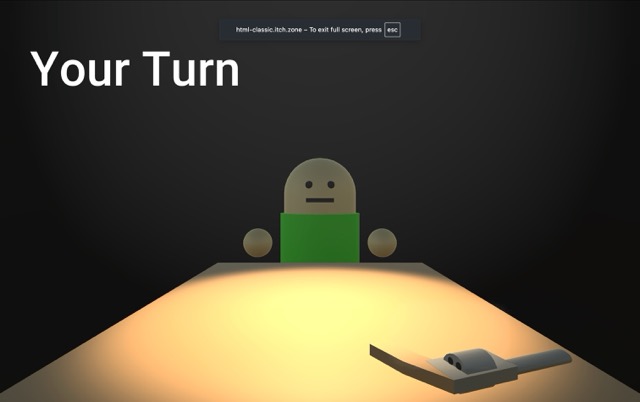
Shotgun Roulette is a tense, mind-game-driven horror shooting game that reimagines the concept of Russian roulette with a shotgun, a monster opponent, and a set of items that change the probability calculations behind every trigger pull. You and your opponent take turns pointing the same gun at yourselves or each other. Some rounds are live. Some are blank. Counting, reasoning, and a willingness to gamble are the only things between you and losing a health bar you can't afford to lose.
The game's antique visual style — aged details, a disturbing monster opponent with a frightening face and unsettlingly long arms — sets a specific tone. This is not a clean, modern shooting game. It feels like something that happened in a back room, under questionable circumstances, with rules that weren't fully explained before the first round loaded. The monster across the table knows those rules better than you do, and it is not rooting for you to win.
What elevates Shotgun Roulette from pure chance into strategic horror is the item system. Handcuffs, beer cans, medicine, and knives are all available over the course of the game, each manipulating the round's probability or consequences in ways that transform lucky guessing into information management. Counting the confirmed types of rounds remaining in the chamber, reading the opponent's behavior, and deploying items at the moment of maximum impact is how winning happens — luck matters, but it's not the only thing that matters.
Multiple rounds. One table. The monster is ready. Are you?
Key Details
| Genre | Horror Strategy / Shooting |
| Difficulty Level | Variable (scales with round progression) |
| Average Play Time | 15–30 minutes per game |
| Best For | Players who enjoy probabilistic strategy games, horror fans drawn to one-on-one psychological pressure, and anyone who wants their shotgun games to require actual thinking |
How to Play Shotgun Roulette
Getting Started
- Understand the bullet types — the chamber contains two types of rounds: live rounds and blank rounds. A live round deals damage; a blank round does nothing. Knowing how many of each type remain in the current chamber is the foundation of every decision you make.
- Count the rounds actively — as rounds are fired — whether live or blank — update your mental count of what remains. If a chamber starts with three live rounds and two blanks, and one blank has been fired, you know the remaining probabilities. This information is the game's core strategic resource.
- Decide each turn: yourself or your opponent — on your turn, you choose to point the gun at yourself or at the monster. If you have strong reason to believe the next round is blank, shooting yourself skips the opponent's turn without risk. If you believe it's live, shooting the opponent deals damage. The decision is yours every time.
- Use items strategically — items become available as the game progresses. Each changes the current situation in specific ways: handcuffs skip the opponent's turn, beer removes a round from the chamber without firing, medicine restores health, and knives double the gun's damage for the next shot. Deploy them at moments when their effect changes the outcome of a round, not as reflexive responses.
- Monitor health on both sides — your health bar and the monster's are visible on screen. The game ends when one side reaches zero. Tracking the margin between health totals informs how aggressively to play in each round.
Basic Controls
| Input | Action |
|---|---|
| Mouse Click | Select action (shoot self, shoot opponent, use item) |
| Item Selection | Click available items to deploy them on your turn |
| Health Bars (UI) | Monitor your health and the monster's health |
| Round Counter (UI) | Track remaining live and blank rounds in chamber |
Objective
Reduce the monster's health to zero before it reduces yours. Each round, choose to fire at yourself (if you believe the next round is blank) or at the monster (if you believe it's live). Use items to manipulate probability and consequences in your favor. Count rounds carefully, deploy items strategically, and outthink a monster that is trying to do exactly the same thing to you.
Shotgun Roulette Features & Highlights
- Probabilistic strategy over pure chance — round counting, information management, and strategic item deployment transform what looks like luck into a game where informed decisions consistently outperform random guessing
- Four item types with distinct tactical functions — handcuffs, beer, medicine, and knives each address different aspects of the round's probability or consequence, creating a deployable toolkit that changes the game's math
- Monster opponent with personality — an antique-styled creature with a disturbing face and long arms provides a genuinely threatening visual opponent whose behavior across rounds provides behavioral data
- Turn-based psychological pressure — the alternating turn structure creates mounting tension across each game as health totals narrow and probability information becomes more precise
- Escalating multi-round structure — multiple rounds with progressively higher stakes ensure the game's strategic demands intensify alongside the horror as the game advances
Shotgun Roulette Tips & Strategies
Beginner Tips
- Always count the rounds out loud or on paper if needed. The round count is the most important information in the game and the one most easily lost under pressure. Each time a round fires — live or blank — update your count. A chamber of three live and two blank rounds that has fired one blank now contains three live and one blank — the next shot is 75% likely to be live. These numbers matter enormously for every decision.
- Shoot yourself when blank probability is high, not just when you're confident. Players new to the game only shoot themselves when they're certain of a blank — which means they rarely do it strategically. If a chamber has one round left and it was shown to be blank (through a beer can removal, for example), shoot yourself: you take no damage and skip the monster's turn. The self-shot is a powerful tool when used with information, not just bravery.
- Save medicine for critical health moments, not comfort. Medicine restores health, which is a finite resource. Using it when health is slightly reduced rather than when it's critically low wastes the item's maximum value. Medicine is most impactful when it prevents a round from being fatal rather than when it repairs comfortable health margins.
Advanced Strategies
- Use handcuffs when the next round is likely live and pointed at the monster. Handcuffs skip the monster's turn — most valuable when you've just shot the monster with a confirmed or probable live round and want to prevent its response while it's vulnerable. Deploying handcuffs when the monster's next action is likely a self-shot (because you've identified the next round as blank) wastes the item's turn-skipping value.
- Use beer strategically, not just to peek. The beer can removes a round from the chamber without firing it — which tells you whether it was live or blank, updating your count, and changes the remaining probability distribution. This is most valuable when the remaining round count is low and precise knowledge of what's left is worth more than the removed round's potential damage.
What to Watch Out For
- Losing count during high-pressure moments. The monster's behavior and health margin pressure can break concentration at exactly the moment when the round count is most important — typically in the final rounds of a chamber when every remaining probability matters most. Build the counting habit during early, lower-pressure rounds so it's automatic by the time the stakes are highest.
- Using the knife without confirming a live round is next. The knife doubles damage on the next shot — maximally effective when the next round is confirmed or very likely live and aimed at the monster. Using it when there's significant blank probability wastes the damage multiplier on a shot that does nothing. Confirm the round situation before committing the knife.
Shotgun Roulette Elements Explained
Round Probability & Counting System
The core mechanic of Shotgun Roulette is information management rather than reflexes or luck. At the start of each chamber, a specific number of live and blank rounds are loaded — this combination is visible or can be inferred — and every shot fired updates the probability distribution of what remains. The game's strategic depth entirely emerges from how well players maintain and use this information across each turn.
The decision structure of each turn is: what do I know about the next round, and given that knowledge, is shooting myself or shooting the monster the higher-value action? When blank probability is high (3 blanks remaining, 1 live), shooting yourself is almost always the better play — you likely take no damage and skip the monster's turn. When live probability is high (1 blank remaining, 3 live), shooting the monster is almost always better. The skill gap between beginners and experienced players is almost entirely about how accurately and consistently they perform this calculation under pressure.
The item system interacts with the probability system in ways that extend the strategic layer. Beer removes a round and reveals its type, updating the count. Knives multiply damage for the next shot, making live-round probability the key determining factor for when to deploy them. Handcuffs skip the opponent's turn, most valuable immediately after a damaging shot. Medicine operates outside the probability system but affects the health margin that determines how much risk is acceptable in each round's decision.
Item System
Four items are available across Shotgun Roulette's rounds, each addressing a different tactical need and most effective when deployed at the right moment rather than as soon as available.
Handcuffs skip the opponent's next turn — the most valuable skip-inducing item in the game and most effectively deployed immediately after a live round hits the monster, preventing its response. Using handcuffs when the monster was likely to shoot itself anyway (because blank probability was high for its expected action) squanders the item's primary value.
Beer cans remove the next round from the chamber without firing it, revealing whether it was live or blank and updating the count. This is a probability-sharpening tool — most valuable in low-count chambers where precise knowledge of remaining rounds changes every subsequent decision. In high-count chambers, the information cost may not justify using the turn.
Medicine restores lost health — the only item that operates outside the probability system entirely. Its timing should be governed by survival need rather than strategic opportunity: save it until health loss threatens the game's outcome, then use it to restore the margin that keeps risky high-value plays viable.
Knives increase the gun's damage for the next shot — a damage multiplier that requires a live round to deliver its value. The knife is the most situationally dependent item in the set: correctly deployed when a live round is confirmed or highly probable, it amplifies a damaging shot into a decisive one. Incorrectly deployed before a blank, it vanishes without effect.
Monster Opponent
The monster in Shotgun Roulette is not just a visual element — it is the game's active opponent, making the same probabilistic calculations you are and deploying the same item types against you. Its antique visual design — disturbing face, impossibly long arms — is a deliberate aesthetic choice that frames the shotgun roulette table as a setting from a different kind of horror than the genre's typical jump scares: something older, stranger, and conducted under its own rules.
The monster's decision-making across rounds provides behavioral data that experienced players can use. If the monster shoots itself under specific probability conditions, that tells you something about its confidence in the round count. If it consistently uses handcuffs at particular moments, that reveals when it perceives you as most vulnerable. Reading the monster's item deployment and self/opponent shot decisions across early rounds provides information that improves your decision accuracy in later, higher-stakes rounds.
The multiple rounds of the game allow the monster's behavior patterns to become legible across a full session in ways that a single-round encounter wouldn't permit. The player who enters the final rounds of a game with a calibrated model of how the monster plays — built from observing its decisions in the preceding rounds — has a meaningful informational advantage over one treating each decision in isolation.
Shotgun Roulette Frequently Asked Questions
Q: How do I know whether to shoot myself or my opponent?
A: Base your decision on the current probability of the next round being live or blank. Track how many live rounds and blank rounds remain in the current chamber — each shot (yours or the monster's) updates this count. If blank probability is higher than live probability, shooting yourself is the better statistical play (you likely take no damage and skip the monster's turn). If live probability is higher, shooting the opponent is better. The decision should follow the math, not instinct.
Q: When is the best time to use each item?
A: Deploy handcuffs immediately after landing a live round on the monster — skip its response while it's damaged. Use beer when the round count is low and precise probability knowledge is worth more than the removed round's potential value. Save medicine for critical health moments rather than comfortable ones. Use the knife only when the next round has high live probability and is aimed at the monster — double damage on a blank round is zero damage.
Q: Is this game compatible with all browsers and devices?
A: Shotgun Roulette is designed for modern desktop browsers, with best performance on Chrome or Firefox on an up-to-date desktop or laptop. The game is entirely mouse-driven — all actions including item selection and shot direction are controlled by clicking — making it potentially playable on touchscreen devices with sufficient click precision, though desktop mouse control is recommended for reliable accuracy under pressure.
Q: What happens when health reaches zero?
A: When either player's health reaches zero, the game ends. If the monster's health reaches zero first, you win and receive the prize money the game promises. If your health reaches zero, the game ends in defeat and resets for a new attempt. Health is tracked on both sides through the energy bar UI visible throughout each round.
Q: Is there any way to guarantee winning, or is it always partly luck?
A: Perfect information and perfect decision-making minimize luck's role significantly but don't eliminate it entirely — the initial chamber loading has a random component that cannot be fully countered through counting alone. What skilled play consistently does is make better decisions given available information, which produces better outcomes on average across multiple games even when individual rounds involve unfavorable probability distributions. The item system exists specifically to give players tools for shifting probability in their favor rather than simply accepting what the chamber loaded.
Games Like Shotgun Roulette You Might Enjoy
If you like Shotgun Roulette, you might also enjoy:
- Dead By Daylight - it matches the same high-pressure horror pacing with dangerous enemies and fast decisions.
- Nightmare of Decay - it matches the same high-pressure horror pacing with dangerous enemies and fast decisions.
- Forsake the Rake - it matches the same high-pressure horror pacing with dangerous enemies and fast decisions.