










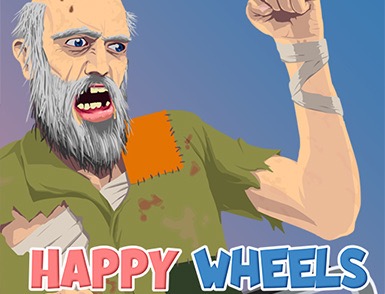
Happy Wheels Overview
Happy Wheels is a physics-based platform game built on ragdoll mechanics, dark humor, and obstacle courses designed to punish every mistake with dramatic, often absurd consequences. You control an unusual character on an equally unusual vehicle — a wheelchair, a bicycle, a segway — and navigate through levels packed with spikes, traps, explosives, and moving hazards. The game is genuinely difficult, frequently chaotic, and consistently entertaining in the way only physics-based failure can be.
The appeal is the combination of challenge and spectacle. Every collision produces a ragdoll reaction — limbs fly, characters tumble, vehicles disintegrate in ways that are unpredictable but always physics-correct. This creates a loop where even failure has entertainment value, which is a significant part of why Happy Wheels has maintained an audience for years. The levels are hard, but watching what happens when they beat you is often as engaging as actually clearing them.
Beneath the chaos is a game that rewards patience and technique. Each character's vehicle handles differently — a wheelchair on a steep slope behaves nothing like a bicycle on a flat track — and learning to read that handling is what separates frantic button-mashing from controlled progress. The variety in level design keeps the experience from becoming repetitive, and the combination of community-created stages and official content means the available course library is enormous.
Key Details
Genre: Physics-Based Platformer
Difficulty Level: Hard
Average Play Time: 10–20 minutes per session
Best For: Players who enjoy physics-based challenges, dark humor, and high-difficulty platformers
How to Play Happy Wheels
Getting Started
- Select a character and their associated vehicle from the character select screen.
- Begin the level — your immediate goal is simply to stay on your vehicle and keep moving forward.
- Use acceleration and balance inputs to navigate slopes, gaps, and obstacles.
- If you encounter a trap or hazard, slow down and approach carefully rather than rushing through.
- Press R to instantly restart after a failed run — quick restarts let you retry a section without waiting.
Basic Controls
Accelerate / move forward: Right Arrow / Up Arrow
Brake / reverse: Left Arrow / Down Arrow
Lean forward: Z or S
Lean backward: A or W
Eject character (certain levels): Spacebar
Restart level: R
Objective: Navigate from the level start to the finish line without dying to obstacles, traps, or hazards. Each level has a defined finish point — reach it with your character (or at least what remains of them) to complete the stage.
Happy Wheels Features & Highlights
- Realistic ragdoll physics — every collision produces a physics-accurate response, making both successes and failures feel dynamic
- Multiple characters with unique vehicles — wheelchairs, bicycles, segways, and more handle distinctly, requiring different techniques
- Obstacle variety — spikes, moving platforms, explosives, and trap sequences require different timing and approach strategies per section
- Instant restart — press R at any moment to immediately retry a section without loading delays
- Dark humor and over-the-top consequences — the game's tone embraces the chaos of ragdoll physics for comedic effect
Happy Wheels Tips & Strategies
Beginner Tips
- Slow down before every obstacle cluster. Speed is useful on open stretches and a liability near traps — learning when to accelerate and when to brake is the primary skill.
- Use R liberally. Quick-restarting after a failure is faster than waiting for the ragdoll animation to complete, and rapid retry cycles build course familiarity faster.
- Observe the first few obstacles before moving. Many traps have visible tells — spike timing, platform movement patterns — that become apparent with a moment's observation.
Advanced Strategies
- Learn the momentum requirements for each jump before attempting at full speed. Some gaps require precise entry velocity — too slow and you fall short, too fast and you overshoot the landing.
- On levels with ejection mechanics (Spacebar), time the eject precisely at peak momentum rather than reactively — controlled ejections give you more airborne control.
- Use lean inputs (forward/backward tilt) to compensate for vehicle imbalance on slopes — keeping your character upright often matters as much as steering direction.
What to Watch Out For
- Chain traps — sections where multiple hazards are sequenced close together, designed to catch players who rush through the first one. Treat every cleared hazard as the entry point to the next one, not a safe zone.
- Overconfidence on familiar levels. Happy Wheels' physics mean that even a well-memorized section can produce unexpected outcomes based on small variations in entry speed or angle.
Happy Wheels Elements Explained
Ragdoll Physics System: Happy Wheels runs on a physics engine that governs how every body part, vehicle component, and environmental object interacts. When your character collides with an obstacle, the result is calculated from actual momentum, contact angle, and force — not from a scripted animation. This means no two crashes look identical, and the game's famous chaotic moments are a direct product of the physics system rather than designed set pieces. The ragdoll model extends to the character's continued existence after significant injury — losing a limb doesn't automatically end a run in many levels, and some players intentionally preserve a damaged character to reach a finish line in a technically alive but structurally compromised state. This system is the primary source of both the game's challenge and its entertainment value.
Character and Vehicle Variety: Each selectable character comes with a specific vehicle, and the combination determines handling characteristics throughout the level. A wheelchair character has different stability on slopes than a bicycle rider, who handles turns differently from a segway user. Vehicle weight, wheel configuration, and character seating position all affect how the vehicle responds to acceleration, braking, and terrain changes. Learning a new character essentially means relearning basic movement behavior for that vehicle type. This variety prevents any single technique from being universally applicable — a slope navigation approach that works for one vehicle may be actively harmful for another.
Level Design and Trap Logic: Happy Wheels levels are structured around escalating obstacle density. Early sections of most levels serve as a warm-up — basic terrain navigation that introduces the level's environment. Middle sections introduce the primary hazards: spikes, moving platforms, falling objects, or triggered traps. Final sections before the finish typically combine multiple hazard types at higher density. Community-created levels vary significantly in design philosophy — some prioritize deliberate precision obstacle navigation, others emphasize speed, and some are designed primarily for the comedic outcomes of failing. The official levels generally follow consistent design logic with clearly telegraphed (if difficult) hazard patterns, while community levels can vary widely in quality and fairness.
Happy Wheels Frequently Asked Questions
Q: How do I eject my character from the vehicle?
A: Press Spacebar on levels that support ejection. Not all characters or levels use this mechanic — it's specific to certain character types and level designs where leaving the vehicle is part of the intended navigation.
Q: What should I do if I can't get past a specific obstacle?
A: Restart (R) and approach it slower. Most impassable obstacles are caused by incorrect entry speed or angle rather than bad luck. Watch what happens on failure for clues — the ragdoll physics often show you exactly where the problem was.
Q: Is Happy Wheels appropriate for younger players?
A: Happy Wheels features dark humor and graphic ragdoll injury content including blood and dismemberment. It is designed for teen and adult audiences and is not appropriate for young children.
Q: Is this the full Happy Wheels game?
A: This browser version embeds Happy Wheels via Miniplay. The original Happy Wheels was developed by Jim Bonacci. Browser availability and level access may differ from the full standalone version.
Q: Can I save my progress through levels?
A: Happy Wheels is a session-based game — each level is played independently without persistent checkpoint saves. Use R to restart the current level at any time during a session.
Games Like Happy Wheels You Might Enjoy
If you like Happy Wheels, you might also enjoy:
- FrontWars.io - it brings similar weapon timing, threat control, and fast action under horror pressure.
- Golf Hit - it brings similar weapon timing, threat control, and fast action under horror pressure.
- Drift Hunters - it shares the same browser horror tension, quick decision-making, and replay-friendly pressure.