














Slope Overview
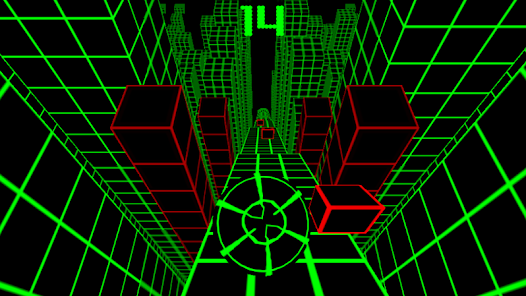
Slope is a 3D endless runner where you guide a ball down a steep neon-lit track that accelerates continuously, generating new obstacles and course geometry as you go. The premise is as simple as it gets: don't fall off the edge, don't hit an obstacle, survive as long as possible. The execution is where it gets interesting.
Slope's defining quality is its pace escalation. The track starts fast and gets faster. By the time you're deep into a run, the combination of speed, randomized obstacle placement, and sudden course shifts demands a level of sustained concentration that few browser games match. Reaction windows that feel generous at low speed become razor-thin at full pace, and the constant acceleration means there's no plateauing at a comfortable difficulty level — the game keeps pushing until you can't keep up.
What keeps players returning is the tight feedback loop. Runs are short when you're learning; the restart is instantaneous; and the gap between your current performance and what you can see is clearly improvable. Players who develop steady centered-movement habits and start anticipating rather than reacting to obstacles consistently extend their runs. The neon aesthetic keeps the course layout readable even at high speed, and the minimalist design removes everything that isn't essential to the running experience. Slope is one of the most played browser arcade games for good reason — it delivers exactly what it promises, immediately, every time.
Key Details
Genre: Arcade / Endless Runner / Reflex
Difficulty Level: Hard (escalates continuously)
Average Play Time: 5–10 minutes per session
Best For: Casual players, reflex game fans, students, speedrunners, anyone seeking a quick skill challenge
How to Play Slope
Getting Started
- Launch the game — the ball begins moving forward automatically down the neon track.
- Use Left and Right Arrow keys (or A/D) to steer the ball left and right.
- Stay on the track — falling off either edge ends the run.
- Avoid red obstacle blocks scattered across the track.
- Survive as long as possible as the speed increases and the course becomes more demanding.
Basic Controls
Steer left: Left Arrow / A
Steer right: Right Arrow / D
Objective: Survive as long as possible on the accelerating track without falling off the edges or hitting obstacles. Your distance or survival time is your score. Beat your previous personal best each session.
Slope Features & Highlights
- Continuous speed escalation — the track accelerates throughout the run, raising the difficulty ceiling without a fixed end point
- Randomized track layouts — obstacle placement and course geometry change every run, keeping each session distinct
- Physics-based ball movement — smooth, accurate response to player input that rewards precise steering over frantic correction
- Minimalist neon visuals — high-contrast design keeps obstacles and track edges clearly readable at speed
- Instant restart — failed runs reset immediately, maintaining momentum in the improvement cycle
Slope Tips & Strategies
Beginner Tips
- Stay centered. A ball in the middle of the track has more margin to react to sudden obstacles or narrow sections than a ball already near the edge.
- Use small, controlled steering inputs rather than sharp corrections. Overcorrecting after drifting toward an edge tends to swing the ball past center to the opposite edge — a cascade that ends runs faster than the original drift would have.
- Keep your eyes ahead. Looking at the ball's current position means reacting to obstacles too late at higher speeds — look at where the track is going, not where you currently are.
Advanced Strategies
- Learn to read obstacle clusters in advance. At high speeds, individual obstacles blur together, but cluster shapes (a group of red blocks forming a gap on the right side) become recognizable patterns that you can route through before fully processing each block.
- Use the track's width actively — position slightly left or right of center when you see an upcoming turn or narrow section, giving yourself a steering buffer in the direction you expect to need it.
- Don't fight the speed. At high pace, steering micro-corrections work better than large direction changes. The ball's momentum means a large input at speed produces a larger movement than intended — smaller inputs give you more control.
What to Watch Out For
- Reacting too late to edge proximity. By the time the ball feels close to the edge at high speed, you're often already falling. Train yourself to correct earlier, when there's still room.
- Tension-induced grip. Hard steering inputs from anxiety about falling produce the overcorrections that cause most falls at mid-to-high speeds. Looser, smaller inputs produce steadier movement.
Slope Elements Explained
Speed Escalation System: Slope's difficulty doesn't come from increasingly complex obstacles — it comes from the relentless pace increase. The track starts at a speed that allows comfortable reaction time and accelerates continuously throughout the run. Obstacles and narrow sections that seem manageable at the start become significantly more demanding at high speed because the reaction window — the time between seeing a hazard and needing to have already responded to it — compresses with every passing second. There is no maximum speed the game locks to; the acceleration continues for as long as you survive. This means the game is always pushing you toward your current limit, and the skill ceiling is effectively open-ended. Players who've run Slope for hours are still facing an escalating challenge rather than a plateau.
Randomized Track Generation: Each Slope run generates a new combination of track geometry, obstacle placement, and course segments from the game's underlying structure. No two runs follow an identical layout, which prevents route memorization and keeps the game's challenge genuinely reflexive rather than pattern-based. The randomization follows consistent logic — tracks are always traversable, extreme obstacle density increases with distance, and the course always has at least one viable steering path through each section — but the specific sequence is new each time. This is what gives Slope its replayability: there's no "solved" route to memorize, only skills to develop. Pattern recognition still applies (clusters of obstacles tend to form navigable gaps, turning sections telegraph their direction early), but the specific pattern is always new.
Ball Physics and Steering Response: Slope's ball movement is physics-based rather than grid-snapped, meaning steering inputs produce a movement arc influenced by the ball's current momentum rather than an instant direction change. At low speed, this is imperceptible — the ball goes where you steer it almost immediately. At high speed, the ball's momentum means inputs have a slightly delayed effect, and overcorrections produce larger swings than intended. Skilled Slope players internalize this momentum carry and apply smaller, earlier inputs rather than sharp reactive ones. The neon visual design supports this by maintaining high contrast between the ball, the track surface, and the obstacles — at high speeds where visual processing is compressed, readability is a functional gameplay requirement rather than an aesthetic choice.
Slope Frequently Asked Questions
Q: How do I restart after a failed run?
A: The game restarts automatically when the ball falls or hits an obstacle, or you can press a key to restart immediately without waiting. Instant restarts keep the improvement cycle fast.
Q: What should I do if the ball keeps falling off the edge?
A: Check whether you're using large steering inputs. Overcorrection causes more edge falls than drifting does. Practice small, early corrections rather than sharp responses to immediate edge proximity.
Q: Is Slope compatible with mobile?
A: Slope runs in browser via HTML5. Keyboard steering controls work best on desktop. Mobile play depends on browser support for on-screen or tilt-based controls.
Q: Can I save my high score?
A: High score tracking saves in your browser session. Some versions include a persistent leaderboard — check in-game for score tracking options.
Q: Why does the ball feel harder to control at high speed?
A: The ball's momentum increases with speed, making steering inputs produce larger movement arcs than they do at lower speed. This is the core physics challenge of Slope at high pace. Adapting by using smaller, earlier inputs — rather than the same inputs as low speed — is the adjustment that extends high-speed survival.
Games Like Slope You Might Enjoy
If you like Slope, you might also enjoy:
- Dashmetry - it shares the same browser horror tension, quick decision-making, and replay-friendly pressure.
- Block Blast - it shares the same browser horror tension, quick decision-making, and replay-friendly pressure.
- Geometry Dash Lite - it shares the same browser horror tension, quick decision-making, and replay-friendly pressure.