



Backrooms Overview
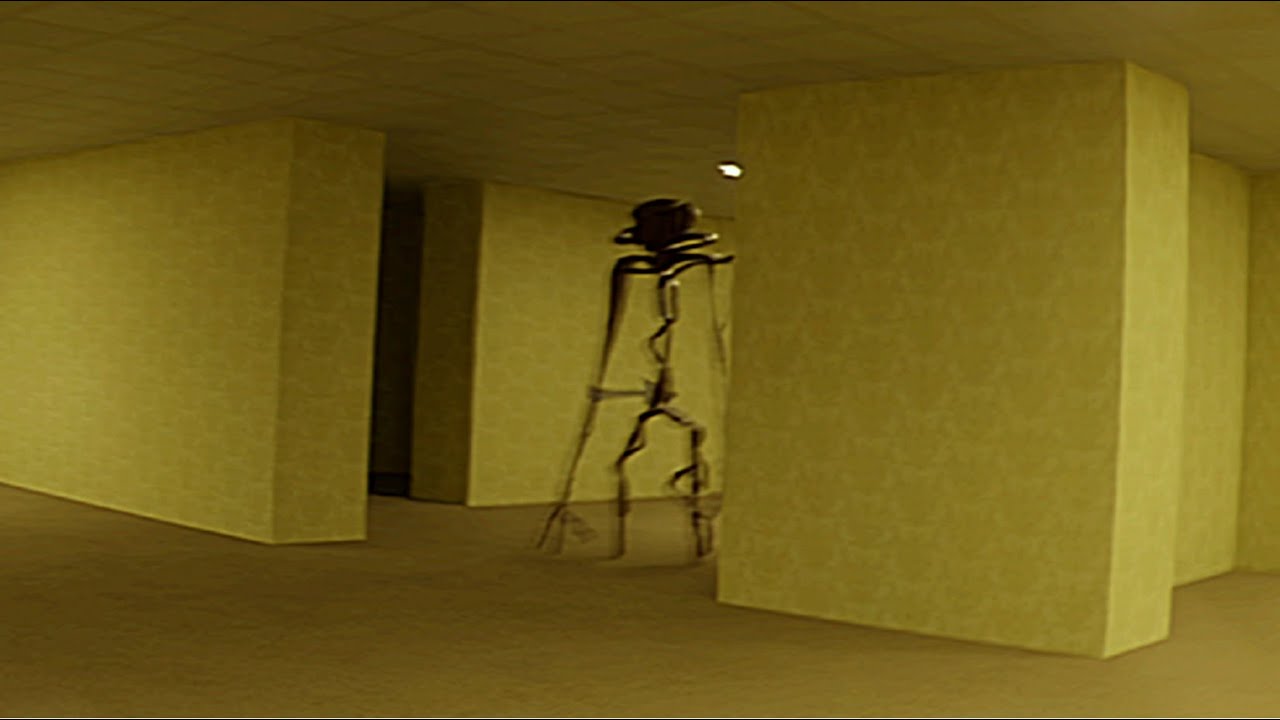
Backrooms is a horror exploration game developed by Esyverse that translates the internet's most enduring liminal space mythology into a navigable three-level escape experience. The setting is immediately recognizable to anyone familiar with the Backrooms lore: yellow walls, rotting carpet, fluorescent humming, the oppressive sense of a space that wasn't meant to be occupied. What begins as environmental dread gradually escalates through three distinct levels, each with its own spatial character and threat profile, culminating in Level 2 — the darkest and most disorienting of the three.
Unlike most horror games in the catalog, Backrooms explicitly avoids jump scares and conventional monsters as its primary threat. The horror here is spatial and psychological: rooms that seem like they should lead somewhere don't, corridors that look familiar turn out not to be, and the evidence of other presence — strange sounds, notes left behind by previous occupants — creates unease through implication rather than confrontation. The "hunting dogs" that appear in Level 0 and the environmental hazards of Level 1 add physical threat, but the game's primary horror tool remains the architecture itself.
Different endings await depending on player choices throughout the exploration, giving Backrooms replay value beyond the initial atmospheric experience.
Key Details
- Genre: Horror Exploration / Liminal Space Survival
- Difficulty Level: Medium
- Average Play Time: 20–40 minutes
- Best For: Backrooms lore enthusiasts, atmospheric horror fans, players who prefer environmental dread over action-based horror
How to Play Backrooms
Getting Started
- Begin in Level 0 and orient yourself using the environment's visual landmarks — yellow walls and fluorescent lighting are your only consistent reference points.
- Move through corridors and rooms systematically rather than randomly, building a mental map of the space as you explore.
- Examine objects and notes you encounter — some are genuine clues from previous occupants; others may be misleading. Context determines which is which.
- Use the F key to select items found during exploration; some objects serve as tools for solving navigation challenges.
- Advance through Level 0, Level 1, and Level 2 by finding exit conditions for each, with difficulty escalating at each transition.
Basic Controls
Move: WASD or Arrow Keys
Jump: Spacebar
Run: Left Shift
Select / Use Item: F
Look Around: Mouse
Objective: Navigate through the three levels of the Backrooms — Level 0 (Corridor), Level 1 (industrial/foggy warehouse), and Level 2 (dark tunnel) — escaping each level's spatial traps and environmental threats while working toward the exit that leads out of the Backrooms entirely.
Backrooms Features & Highlights
- Three distinct Backrooms levels — Level 0 (Corridor), Level 1 (warehouse with fog and standing water), and Level 2 (darkest industrial tunnel) each provide a different environmental character and threat profile
- Liminal space horror design — architecture, not monsters, is the primary threat; the horror comes from spatial disorientation and implied presence rather than confrontation
- Environmental storytelling — notes left by previous occupants create narrative context while introducing uncertainty about which are genuine guidance and which are misdirection
- Multiple endings — player choices throughout the exploration affect which conclusion becomes available
- Faithful Backrooms aesthetic — yellow walls, rotting carpet, and fluorescent lighting from the iconic Level 0 photograph ground the game in the established lore
Backrooms Tips & Strategies
Beginner Tips
- Build a mental map of explored corridors rather than navigating by feel — the Backrooms' architecture is designed to confuse directional intuition, and consistent room-by-room mental tracking is more reliable than instinct.
- Read every note you find, but don't immediately trust it — the game explicitly acknowledges that some notes may be misdirection from previous "players" rather than genuine guidance.
- Listen carefully to the spatial audio; strange sounds from distant corners are meaningful rather than random. They indicate something is present in a specific direction, not simply ambient horror decoration.
Advanced Strategies
- Level 2 is the exit-enabling level but also the darkest and most disorienting — entering it with a clear mental model of what you're looking for (based on clues from Levels 0 and 1) produces better outcomes than exploring it without orientation.
- The hunting dogs in Level 0 follow behavioral patterns that become partially predictable across multiple encounters — studying their movement rather than simply avoiding them provides information about safe corridor timing.
- Different ending conditions appear to be tied to specific investigation choices rather than a single final decision — approaching the game as an investigation rather than a linear escape produces the range of endings the game offers.
What to Watch Out For
- Objects described as "useless" in rooms are specifically flagged as potentially significant clue items — the game's hint that strange objects serve puzzle purposes applies to items that look like they shouldn't matter.
- Level 1's flickering or absent lighting creates genuine visibility problems that running through too quickly produces; moving through dark sections slowly allows environmental reading that fast movement prevents.
Backrooms Elements Explained
Three-Level Structure: Backrooms structures its horror across three escalating environments drawn from the internet's established Backrooms lore. Level 0 (the Corridor) is the iconic starting point: yellow walls, rotting carpet, fluorescent lighting, and hunting dogs as the primary creature threat. Level 1 introduces an industrial aesthetic with machinery, fog, and standing water that creates both navigation difficulty and additional hazard. Level 2 is the darkest level — a long tunnel with industrial design where the absence of light is the primary environmental challenge. Each level transition requires completing that level's exit conditions rather than simply finding a door, making progression feel earned rather than automatic.
Environmental Horror & Note System: Backrooms' primary horror tool is spatial — the architecture of the levels creates disorientation and implied presence rather than providing monsters as the central threat. The note system adds a narrative layer to this environmental approach: notes left by previous occupants create context for what the Backrooms is and what has happened to others who found themselves there, while also introducing uncertainty about source credibility. The game explicitly frames some notes as genuine guidance and others as potential misdirection, requiring players to cross-reference note content against environmental evidence rather than treating any single information source as authoritative. This uncertainty is itself a horror element — you're navigating a space where even the help you receive may not be what it appears to be.
Multiple Endings & Choice System: Backrooms provides different conclusions based on choices made during the exploration rather than a single fixed escape outcome. The choice system appears to operate through investigation decisions — what you examine, which notes you act on, and how you approach specific environmental challenges — rather than explicit dialogue selections. This makes the multiple endings emerge naturally from play behavior rather than being confined to discrete choice moments, rewarding players who approach the game as an investigation with genuine curiosity rather than as a linear navigation exercise.
Backrooms Frequently Asked Questions
Q: How do I progress from Level 0 to Level 1 in Backrooms?
A: Leave the "noclip zone" — a specific spatial interaction in Level 0 that the game communicates through environmental cues and notes. Continuing to explore Level 0 systematically will reveal the transition condition rather than it being a hidden unmarked mechanic.
Q: What should I do if I feel completely lost in the corridors?
A: Stop moving and observe the current space carefully for any visual landmark (a distinctive wall feature, furniture placement, lighting variation) that can anchor your position. Build back outward from that landmark rather than continuing movement in a potentially wrong direction.
Q: Is Backrooms compatible with mobile devices?
A: Yes. The game is built in HTML5 by Esyverse and supports browser play on desktop, tablet, and mobile.
Q: Can I save my progress?
A: Backrooms is a browser-based game. Check the in-game menu for available save options; progress behavior may vary by browser session.
Q: Are the "hunting dogs" the only creatures in the game?
A: Hunting dogs appear in Level 0. Level 1 introduces different environmental hazards alongside its creature threats, and Level 2's challenges are primarily environmental rather than creature-based. Each level introduces its own specific threats.
Games Like Backrooms You Might Enjoy
If you like Backrooms, you might also enjoy:
- Nightmare Kart - it shares the same browser horror tension, quick decision-making, and replay-friendly pressure.
- Horror Tale 2 - it shares the same browser horror tension, quick decision-making, and replay-friendly pressure.
- Sprunki Pyramixed - it shares the same browser horror tension, quick decision-making, and replay-friendly pressure.