
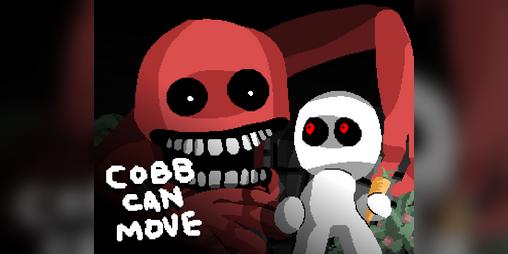







Cobb Can Move Overview
Cobb Can Move is a pixel horror survival game built around a single mechanic that changes everything: Cobb gains new abilities between levels, and you only learn the new rules when you enter the room. Each stage tells you what changed — maybe loud footsteps now attract attention, maybe visibility works differently, maybe proximity triggers something you didn't expect — and then the maze that looked familiar a moment ago becomes a new problem to solve. What worked last level may be the exact behavior that gets you caught this level.
The game's design philosophy centers on adaptation over optimization. There are no permanent skill progressions, no fixed strategies that apply universally, and no safe behaviors that remain safe across all levels. Safe corners feel exposed when a new rule makes visibility dangerous. Familiar routes become liabilities when Cobb's movement detection changes. The constant shifting of the threat model is what produces the psychological tension that the game describes as its core experience — not jump scares, but the sustained stress of never being entirely certain that your current approach is the right one.
Cobb Can Move rewards players who read carefully, stay calm under pressure, and adapt their mental model of the maze before moving rather than discovering the rule change by triggering it.
Key Details
- Genre: Pixel Horror Survival / Maze Exploration
- Difficulty Level: Medium–Hard
- Average Play Time: 20–40 minutes
- Best For: Horror puzzle fans, players who enjoy adaptive difficulty design, stealth game enthusiasts who want a mechanically inventive take on the genre
How to Play Cobb Can Move
Getting Started
- Launch the game and, at each new level, read the stage instructions before moving — the rule changes are communicated here, and entering without reading is the single most common mistake.
- Identify how the new rule affects your planned behavior: does it change how much noise you make, how visible you are, how close Cobb can safely approach?
- Navigate the dark top-down rooms to collect required objects while keeping your behavior consistent with the current level's rules.
- Maintain spatial awareness of Cobb's position — the goal is always to open safe paths to the objective before Cobb closes that distance.
- When multiple rules are active simultaneously, prioritize the rule that restricts the widest range of your behaviors first.
Basic Controls
Move: WASD or Arrow Keys
Interact with objects: E or Spacebar
Objective: Explore each level's dark maze, collect required objects, and reach safe paths before Cobb closes in — adapting your movement and behavior to each level's specific rule set as Cobb gains new hunting abilities between stages.
Cobb Can Move Features & Highlights
- Per-level rule-change system — Cobb gains new abilities between stages, fundamentally altering how movement, sound, visibility, and positioning work in each new room
- Compounding rule mechanics — when multiple rules become active simultaneously, safe options narrow in ways that require careful multi-variable thinking rather than single-rule responses
- Top-down pixel horror aesthetic — dark room layouts and shifting maze configurations create constant spatial uncertainty across levels
- Calm-over-speed design philosophy — panicked rushing is consistently penalized; deliberate adaptation is consistently rewarded
- Psychological tension model — sustained stress from rule uncertainty replaces discrete jump scares, creating horror through ongoing cognitive pressure
Cobb Can Move Tips & Strategies
Beginner Tips
- Read the level instructions completely before making a single movement — the source material identifies rushing into dark rooms without reading conditions as the most common survival mistake, and it's accurate.
- After reading the new rule, spend a moment mentally mapping which of your standard behaviors it penalizes before beginning movement. A few seconds of pre-planning consistently produces better outcomes than reactive adaptation.
- When unsure about the current rule's implications, move conservatively and observe Cobb's response — his reaction to your movement is the clearest real-time feedback on whether your behavior is triggering the rule.
Advanced Strategies
- When multiple rules are simultaneously active, identify which one restricts the broadest range of your movement options and design your navigation around that constraint first. The more specific rules can typically be satisfied within the space that the broadest constraint allows.
- Learn the level layout geometry before worrying about Cobb's position — escape paths are always present, but they're only useful if you know where they are before you need them.
- Use the calm between level transitions to fully reset your mental model of safe behavior rather than carrying assumptions from the previous stage. A behavior that was optimal two levels ago may be precisely what the current rule penalizes.
What to Watch Out For
- Following routes that worked in previous levels is the most reliable path to failure in later stages — each rule change invalidates some portion of established behavior.
- The source material explicitly notes that panicked movement during chase situations leads players directly into dangerous spaces. When Cobb closes in, prioritize finding a nearby escape path over maintaining your original collection route.
Cobb Can Move Elements Explained
Per-Level Ability Escalation: Cobb's ability to gain new hunting capabilities between levels is the mechanic that defines everything about how Cobb Can Move plays. The abilities affect different behavioral dimensions: some levels penalize sound (loud footsteps trigger Cobb's attention), others affect visibility (your position becomes dangerous at certain distances or angles), and others change movement safety (previously safe speeds or locations become triggering). The game communicates each new ability through stage instructions at the level's start — reading these is not optional, it is the first gameplay action of every stage. The escalation across the full game represents a cumulative constraint accumulation: by the later levels, multiple abilities may be simultaneously active, creating a situation where player behavior must satisfy several independent restrictions at once.
Compounding Rule System: The most mechanically demanding aspect of Cobb Can Move is its compounding rule mechanic — levels where more than one of Cobb's abilities is simultaneously in effect. A single rule constrains one dimension of behavior (don't make noise, don't get too close, don't move too fast); two simultaneous rules constrain two dimensions, creating a behavioral space that is the intersection of both constraints. Three simultaneous rules can reduce safe behavior to a narrow set of specific actions that satisfy all active restrictions. The game's design ensures this narrowing is always navigable — there is always a path through the level that satisfies all active rules — but finding it requires thinking through each constraint's implications rather than moving on instinct.
Maze Layout & Navigation Design: Cobb Can Move uses dark, top-down pixel room layouts that change in configuration across levels, preventing spatial familiarity from becoming a reliable advantage. The rooms are navigable but not immediately readable — dark areas limit visibility, and the maze structure creates routes that may dead-end or loop back unexpectedly. The game's source material identifies specific failure patterns around maze navigation: rushing through dark rooms without reading conditions, following old routes after monster abilities change, and ignoring escape paths during chase sequences. These patterns reflect the game's expectation that players will attempt to apply prior knowledge from earlier levels to new situations — a consistently penalized approach. Each level effectively demands a fresh assessment rather than confidence built on past success.
Cobb Can Move Frequently Asked Questions
Q: How do I find out what Cobb's new ability is in each level?
A: Read the stage instructions presented at the beginning of each new level. These instructions communicate what has changed about Cobb's hunting behavior — they are the primary game interface for rule communication and should be read completely before making any movement.
Q: What should I do when Cobb is actively chasing me?
A: Don't panic — rushed movement during chases leads directly into dangerous spaces. Look for the nearest escape path you've already identified and move toward it deliberately. Panicked route changes typically produce worse outcomes than committing to a pre-identified path.
Q: Is Cobb Can Move compatible with mobile devices?
A: Yes. The game is built in HTML5 and supports browser play on desktop, tablet, and mobile, though the keyboard control scheme is best suited to desktop play.
Q: Can I save my progress?
A: Cobb Can Move is a browser-based game. Progress within a session is maintained, but check whether the game supports cross-session progress saving in your browser.
Q: What happens if multiple rules are active and I don't know which one triggered Cobb?
A: Review your recent behavior against each active rule individually. The specific action that caused the trigger will typically be the most recently changed behavior — something you did in this level that you weren't doing in the last. Use Cobb's response timing relative to your actions to narrow down which rule was triggered.
Games Like Cobb Can Move You Might Enjoy
If you like Cobb Can Move, you might also enjoy:
- Nightmare Kart - it shares the same browser horror tension, quick decision-making, and replay-friendly pressure.
- Horror Tale 2 - it shares the same browser horror tension, quick decision-making, and replay-friendly pressure.
- Sprunki Pyramixed - it shares the same browser horror tension, quick decision-making, and replay-friendly pressure.