
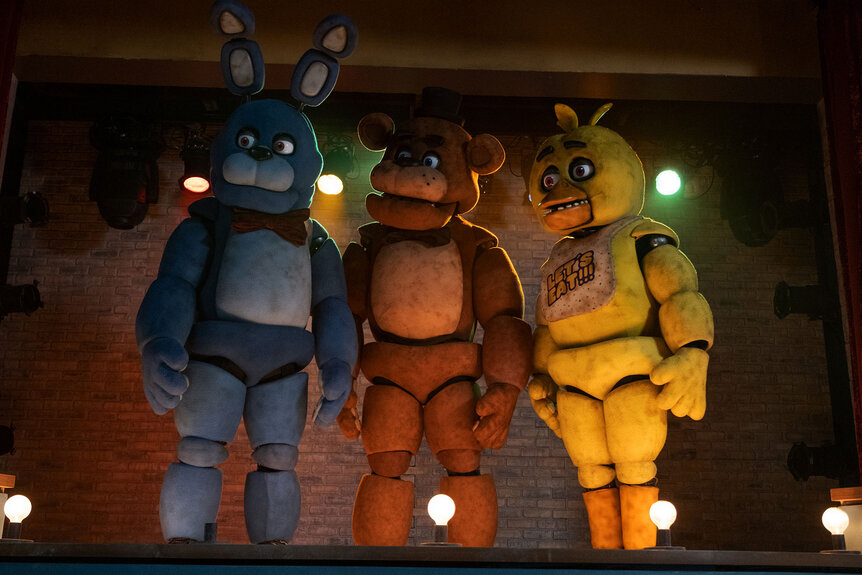


Five Nights at Fazbear's Overview
The listing made it sound routine: night security guard, pizza restaurant, minimal foot traffic after closing. What the listing left out was everything that happens after midnight, when the animatronics stop being decorations and start being the reason you regret taking the job.
Five Nights at Fazbear's is a survival horror game built on the most fundamental tension in the genre: you are in a small room, you cannot leave, and something is moving toward you. Your only tools are a camera system that shows you where the animatronics are, hallway lights that show you if they're already at your door, and security doors that can stop them — but only as long as your power holds out. Every camera check, every light flash, every closed door draws from the same finite supply of electricity. Run out before 6:00 AM and everything stops working, the building goes dark, and you are completely alone in that silence.
What makes Five Nights at Fazbear's distinctive is the purity of the fear it generates. There are no weapons, no escape routes, no QTEs, and no mechanics that make you feel more powerful as you progress. The animatronics get faster every night. Your power stays exactly as limited. The only thing that changes is how much you've learned — which cameras matter most, which animatronic to watch first, how long a door can stay closed before it costs too much. It's a game about information, patience, and nerve, and it rewards all three in exactly the way it punishes their absence.
Key Details
- Genre: Survival Horror / Strategy
- Difficulty Level: Variable (escalates significantly across nights)
- Average Play Time: 10–20 minutes per night attempt
- Best For: Fans of camera-and-door survival horror who want a focused, atmospheric experience with genuine resource tension
How to Play Five Nights at Fazbear's
Getting Started
1. Open the security camera system at the start of your shift and establish each animatronic's starting position — knowing where they begin is your baseline for tracking movement throughout the night. 2. Cycle through camera feeds regularly, watching for animatronics that have left their starting locations and identifying which direction they're heading. 3. Use the hallway lights outside each door to check the blind spots that cameras cannot cover — the corridors immediately adjacent to your office. 4. Close the door on whichever side an animatronic is approaching, then reopen as soon as it has moved on to conserve power. 5. Manage your electricity carefully throughout the night and survive until the clock reaches 6:00 AM.
Basic Controls
- Mouse: Switch between camera feeds and operate all office controls
- Light Buttons: Click to turn hallway lights on and check for animatronics outside each door
- Door Buttons: Click to close or open the security doors on either side of the office
- Camera Monitor: Toggle open to view the restaurant's security feeds and track animatronic positions
Objective: Monitor the animatronics through the camera system, use lights to check hallway blind spots, and close doors before animatronics can enter your office. Survive from midnight to 6:00 AM without running out of power.
Five Nights at Fazbear's Features & Highlights
- Power management as the central tension — every defensive action draws from a finite electricity supply that must last the entire night, making every decision genuinely consequential
- Camera-and-door survival formula — a clean, focused implementation of the genre's defining mechanics without superfluous systems
- Escalating nightly difficulty — animatronics become faster and more aggressive with each successive night, steadily reducing the margin for error
- Fear through restraint — no combat, no escape options, and no power fantasy; survival depends entirely on awareness and timing
- Atmospheric tension design — dread built through waiting and listening rather than constant action, rewarding patience and focus over reflexes
Five Nights at Fazbear's Tips & Strategies
Beginner Tips
- Use Night 1 to map the cameras. Spend time identifying which feeds cover which areas of the restaurant before the animatronics become genuinely threatening — spatial familiarity with the camera layout pays dividends on every subsequent night.
- Close doors only when you've confirmed a threat in the hallway. The single most common cause of power failure before 6:00 AM is precautionary door closures — always use the hallway light to verify before spending power on a closed door.
- Keep camera sweeps brief. A quick glance at each room is sufficient to register movement — lingering wastes power and leaves other areas unmonitored while you're focused on one feed.
Advanced Strategies
- Learn each animatronic's movement sequence. Most animatronics follow identifiable camera-to-camera paths before reaching the hallway adjacent to your office — recognizing which cameras signal an incoming approach gives you earlier warning and more time to manage the response.
- Develop a power budget for each hour. The night runs six in-game hours and power depletes continuously — knowing roughly how much power each hour of camera monitoring and door use costs helps you identify when you're running ahead or behind your sustainable pace.
- On later nights, shift toward audio-based detection. The sounds of animatronic movement — footsteps, mechanical sounds, environmental cues — provide information without the power cost of the camera monitor. Using audio during the monitor's downtime reduces total power expenditure on high-pressure nights.
What to Watch Out For
- Never let power reach zero with more than an hour remaining. At 0%, all systems fail simultaneously and the building goes dark — this is always fatal. Begin aggressive conservation below 20% regardless of how manageable the animatronics currently seem.
- Don't treat a quiet stretch as safety. Animatronics can remain stationary for extended periods before moving quickly — complacency during quiet moments is when positioning awareness lapses, and lapses are how you discover something has reached your hallway without warning.
Five Nights at Fazbear's Elements Explained
Power Management: The electricity system is the defining mechanical constraint of Five Nights at Fazbear's. A finite power supply depletes throughout the night at a baseline rate, with every active system accelerating that drain. The camera monitor, hallway lights, and security doors all draw from the same pool, with doors representing the most expensive individual action. Keeping a door closed for an extended period burns power at a rate that can destabilize an otherwise manageable night — doors are last-resort tools, not a first response. When power reaches zero, all defensive systems shut down simultaneously. The building goes dark and the doors open, leaving the office fully exposed for the rest of the night. Surviving to 6:00 AM from that state is, in practice, not possible. Every decision across the full six hours must be weighed against its power cost, making the electricity meter the constant context for every other choice in the game.
Camera and Light System: The restaurant's security camera network covers the main areas of the building — stages, dining areas, hallways, and connecting spaces — giving you a view of the animatronics' positions across most of the building. The critical limitation is the blind spots immediately outside each security door: cameras cannot cover these hallways, only the hallway lights can. Using the lights to check the door-adjacent corridors adds information about the most immediately dangerous positions in the building but costs power for each use. Efficient play involves a practiced rotation between camera monitoring (for building-wide awareness) and light checks (for immediate threat confirmation), minimizing the time and power spent on each without letting either go unchecked long enough for an animatronic to arrive undetected.
Animatronic Behavior: The animatronics move through the restaurant autonomously once the night begins, each following its own movement logic and escalating in aggression as the nights progress. On early nights they move slowly enough to give generous reaction time between detection and response. On later nights the same window compresses significantly — an animatronic spotted moving toward your hallway on Night 1 gives you several camera cycles before arrival; on Night 5 the same movement may require an immediate response. Each animatronic approaches via specific routes through the restaurant, and learning those routes is the core long-term skill the game develops. Players who survive consistently are those who have internalized not just where the animatronics are but where they will be next based on what the cameras currently show.
Five Nights at Fazbear's Frequently Asked Questions
Q: How do I check if an animatronic is right outside my door?
A: Click the light button on the left or right side of the office — not the camera button — to flash the hallway outside that door. If an animatronic is visible in the hallway, close the door immediately. If the hallway is empty, leave the door open to conserve power.
Q: What should I do if power gets critically low before 6 AM?
A: Stop using the camera monitor entirely and rely only on hallway light checks for threat detection. Open any closed doors the moment a threat has clearly passed. Avoid all non-essential power usage and listen for audio cues to compensate for reduced camera monitoring. Prevention — monitoring power levels continuously and adjusting usage before they become critical — is significantly more reliable than managing a near-zero power situation reactively.
Q: Why do the animatronics seem to arrive faster on later nights?
A: Each successive night increases animatronic activity levels and movement speed. The camera rotation that gave you adequate reaction time on Night 2 may be too slow to catch movement before it reaches your hallway on Night 4. On later nights, increase the frequency of your camera sweeps and prioritize hallway light checks over extended camera monitoring sessions.
Q: Can I save my progress between nights?
A: Completed nights are saved automatically upon surviving to 6:00 AM. Your progress is preserved for the next session and the following night is unlocked.
Q: Is there content beyond the main nights?
A: Completing the five main nights may unlock additional challenge content — check the main menu after completing Night 5 for any available bonus nights or custom difficulty options.
Games Like Five Nights at Fazbear's You Might Enjoy
If you like Five Nights at Fazbear's, you might also enjoy:
- Five Nights at Freddy's - it shares the same animatronic pressure, survival timing, and quick browser play rhythm.
- Five Nights at Freddy's 2 - it shares the same animatronic pressure, survival timing, and quick browser play rhythm.
- Five Nights at Freddy's 3 - it shares the same animatronic pressure, survival timing, and quick browser play rhythm.