
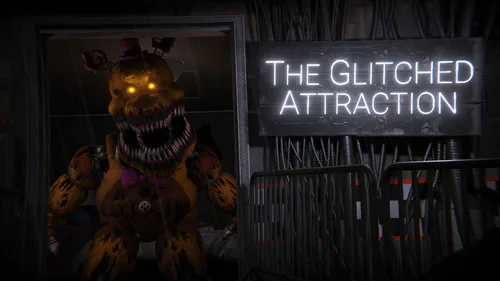




FNAF Glitched Attraction Overview
Something is wrong with the attraction. The robots know it too.
FNAF Glitched Attraction is a survival horror escape room game that fuses the animatronic dread of the Five Nights at Freddy's universe with the puzzle-solving structure of a classic escape room — and then corrupts both with a glitch aesthetic that makes every level feel like it's about to break apart at the seams. Each room is a contained challenge with its own layout, its own animatronic threats, and its own set of puzzles standing between you and the exit.
What distinguishes FNAF Glitched Attraction from standard FNAF-style survival games is the active puzzle layer. This is not a game of passive monitoring and reactive hiding — it demands that you search the environment for clues, locate and use objects in the correct ways, and solve the room's puzzle system while simultaneously managing the animatronic threats closing in around you. The escape room structure means every space has a solution, and finding it before time runs out is the challenge.
The game's environmental management systems add a third layer of pressure. Cameras, lights, and air conditioning units are tools available to you in each room, but using them requires attention and resource discipline. Cameras reveal animatronic positions; lights can deter threats; air conditioning affects the acoustic environment that animatronics use to track you. Getting the most out of these systems while keeping your puzzle-solving momentum going is the skill that separates survivors from the ones who don't make it out.
Unpredictable, puzzle-driven, and persistently tense, FNAF Glitched Attraction is a must-play for horror fans who want their FNAF experience to demand more than nerves alone.
Key Details
| Genre | Survival Horror / Escape Room Puzzle |
| Difficulty Level | Hard |
| Average Play Time | 20–40 minutes per run |
| Best For | FNAF franchise fans, escape room enthusiasts, and survival horror players who enjoy active puzzle-solving under time pressure and threat |
How to Play FNAF Glitched Attraction
Getting Started
- Scan the full room before touching anything — when you enter a new level, take a moment to observe every piece of furniture, every wall, and every object in the space before interacting with anything. The hints and items you need are embedded in the room's details, and knowing what's present before you start solving prevents costly backtracking.
- Identify and collect usable objects early — items needed to solve each room's puzzles are distributed throughout the environment. Locate and pick up everything interactive as a first priority before the animatronics begin closing distance.
- Establish camera and light coverage — access the available cameras and lights to get an initial picture of animatronic positions. Understanding where the threats are before you're deep into puzzle-solving gives you time to plan your approach and react before a robot is on top of you.
- Solve puzzles in order of urgency — not every puzzle element in a room is equally time-sensitive. Prioritize the components that unlock exits or create safe zones before working on secondary puzzles, and keep the time remaining in view throughout.
- Try alternative routes when blocked — if an animatronic is occupying the path to a puzzle element or exit, look for another route through the room rather than waiting for the robot to move on its own. Most levels have more than one viable path.
Basic Controls
| Input | Action |
|---|---|
| Mouse Click | Interact with objects, examine clues, use items |
| WASD / Arrow Keys | Move through the room |
| E | Pick up items / interact with environment |
| Camera Controls | Monitor animatronic positions via room cameras |
| Light Controls | Toggle room lighting to deter or observe threats |
| Air Conditioning Controls | Manage acoustic environment to reduce animatronic tracking |
| Inventory (UI) | Access and use collected items and clues |
Objective
Escape each level before the timer expires by finding clues, collecting objects, and solving the room's puzzle system — all while evading the animatronic robots that share your space. Use cameras, lights, and air conditioning strategically to manage threats without neglecting the puzzle-solving that unlocks your way out. Clear every level to complete the attraction.
FNAF Glitched Attraction Features & Highlights
- Escape room puzzle structure — each level is a self-contained puzzle environment with its own clues, objects, and solution sequence, demanding active problem-solving rather than passive monitoring
- Multi-system environmental management — cameras, lights, and air conditioning each serve distinct functions in detecting and managing animatronic threats, creating a layered toolkit that rewards strategic use
- Level-by-level escalating challenge — each room introduces unique layouts, puzzle configurations, and threat behaviors, ensuring no two levels play identically and difficulty increases meaningfully across the full run
- Time pressure mechanic — a visible countdown timer in each room makes efficient puzzle-solving as critical as threat evasion, preventing players from taking a methodical, unhurried approach
- Glitched aesthetic and atmosphere — the game's visual corruption aesthetic adds an unsettling layer of unpredictability to both the environments and the animatronic behaviors, making each level feel genuinely unstable
FNAF Glitched Attraction Tips & Strategies
Beginner Tips
- Furniture is your first clue source — examine everything. Desks, shelves, cabinets, and other room fixtures frequently conceal the hints and objects needed to progress. New players who search only the obvious interactive elements miss a significant portion of available clues. Click on every piece of furniture in a new room before committing to a puzzle approach.
- Don't solve puzzles sequentially if the room allows parallel progress. When multiple puzzle elements are available simultaneously, work across them rather than completing one fully before starting the next. Partial progress on several components often reveals connections between them that accelerate the full solution.
- Check the timer before and after every major action. The countdown is always visible, but the most common mistake is forgetting to account for it while absorbed in a puzzle. Build the habit of glancing at the remaining time before committing to any sequence of actions that might take longer than expected.
Advanced Strategies
- Use cameras to establish animatronic patrol patterns, not just current positions. A single camera check tells you where a robot is now; watching it across two or three checks reveals where it tends to go. Understanding patrol tendencies lets you predict when a path to a puzzle element will be briefly safe rather than waiting passively for an opening.
- Manage air conditioning proactively, not reactively. The air conditioning system affects how effectively animatronics can track you through sound. Adjusting it before entering a particularly noisy puzzle-solving sequence — rather than after the robot has already been drawn in by the sound — is consistently more effective than reactive correction.
What to Watch Out For
- Resource depletion from overusing environmental systems. Cameras, lights, and air conditioning are tools with costs. Running all three systems simultaneously at full capacity while puzzle-solving is unsustainable across a full level. Identify which system is providing the most value at any given moment and prioritize it over the others rather than running everything at once.
- Tunnel vision on a single puzzle element. Escape room puzzle design sometimes leads players to fixate on one component while ignoring the others. In FNAF Glitched Attraction, this is doubly dangerous — not only does it slow puzzle progress, but it allows animatronics to close distance unnoticed while your attention is locked on a single point. Keep your awareness distributed even when one puzzle element is frustrating you.
FNAF Glitched Attraction Elements Explained
Escape Room Puzzle System
The puzzle system is the structural core of FNAF Glitched Attraction and the element that most clearly differentiates it from standard FNAF survival experiences. Each level is designed as a contained escape room: clues distributed throughout the environment, objects that must be found and used in the correct contexts, and a solution sequence that unlocks the exit. Nothing is arbitrary — every furniture piece, every note, every seemingly incidental object has a potential role in the room's solution.
Effective puzzle-solving in this game requires the same foundational discipline as any escape room: complete observation before action. The impulse to start interacting with the first clearly interactive object you encounter is natural but frequently counterproductive — the object may require a companion item you haven't found yet, or its function may depend on context established by a clue in a different part of the room. A full environmental survey at the start of each level prevents wasted interactions and builds the complete picture the solution requires.
The puzzle system also intersects with the threat management layer in ways that create genuine decision tension. Sometimes the most efficient puzzle-solving route passes through an area currently occupied by an animatronic. Sometimes a puzzle solution requires making noise that will attract robots. Navigating these intersections — finding the approach that advances the puzzle while maintaining acceptable threat management — is where the game's real depth emerges.
Environmental Management Systems
Three distinct environmental systems — cameras, lights, and air conditioning — give players active tools for managing the animatronic threats in each room. Each operates differently and serves a different function, and using them well requires understanding not just what each does individually but how they interact with each other and with the puzzle-solving demands of the current level.
Cameras provide positional awareness: they reveal where animatronics are within the room and, over multiple checks, establish the patrol patterns that let you predict their movements. Camera use is primarily informational — it tells you what's happening rather than directly affecting it.
Lights serve a deterrent function. Properly used, they can slow or redirect animatronics approaching your position, buying time for puzzle-solving or repositioning. They are the most directly defensive of the three systems.
Air conditioning affects the acoustic environment of the room. Animatronics track partly through sound, and the air conditioning system modulates how effectively ambient noise in the room assists their tracking. Managing it reduces the unintentional audio signals generated by active puzzle-solving, making the room's sound environment less informative to animatronics during critical sequences.
Level Structure & Time Pressure
Each level in FNAF Glitched Attraction is a self-contained challenge with its own spatial layout, puzzle configuration, animatronic behaviors, and countdown timer. The game does not have a single, unified map — instead, it progresses through a series of distinct rooms, each requiring a fresh observation-and-solution approach. This structure ensures the game remains actively engaging across its full runtime rather than becoming an exercise in memorizing a single fixed environment.
The countdown timer running through each level is the primary mechanical pressure system. Unlike survival horror games where time pressure is implicit — how long until the animatronic reaches you — the visible timer makes the deadline concrete and immediate. Every second spent on an unproductive action, every route taken that leads to a dead end, every puzzle interaction that fails because a required item hasn't been collected yet — all of these have a directly visible cost.
Managing time effectively means treating each level as having two concurrent challenges: the puzzle solution and the animatronic threat. Players who solve puzzles efficiently but ignore threats until they become critical, or who manage threats carefully but solve puzzles too slowly, will both hit the timer before the exit opens. The winning approach integrates both — advancing the puzzle while keeping just enough threat awareness active to avoid dangerous proximity.
FNAF Glitched Attraction Frequently Asked Questions
Q: How do I find hidden clues and objects in each room?
A: Examine every piece of furniture and every surface in the room before starting to solve any puzzles — desks, shelves, cabinets, and decorative objects frequently contain the hints and items you need. Click on anything that appears interactive, even if it doesn't look immediately relevant. If you're stuck on a puzzle, return to any furniture or objects you haven't fully examined — a missed clue is the most common cause of puzzle blocks in this game.
Q: What should I do if an animatronic is blocking the path to a puzzle element I need?
A: First, check the cameras to confirm the robot's current position and assess whether it's actively patrolling toward you or holding in a fixed area. If it's mobile, use the lights to deter it from your direction or wait for a patrol gap that opens the path briefly. If the blockage seems persistent, look for an alternate route through the room — most levels have more than one viable path to each puzzle component. As a last resort, use any available audio or environmental tools to redirect the animatronic's attention elsewhere long enough to complete the interaction.
Q: Is this game compatible with all browsers and devices?
A: FNAF Glitched Attraction is designed for modern desktop browsers, with best performance on up-to-date versions of Chrome or Firefox on a desktop or laptop. The game uses a combination of keyboard and mouse controls, making touchscreen and mobile devices less suitable for the full experience. Audio design is integral to threat detection in this game — headphones or quality speakers are strongly recommended.
Q: Can I save progress between levels?
A: Progress through completed levels may be retained within an active browser session. Closing or refreshing your browser tab risks resetting your progress, so completing full level sequences before exiting is advisable. Check the in-game menu for any available save or checkpoint options before ending a session.
Q: How do the air conditioning controls affect gameplay, and when should I use them?
A: The air conditioning system influences how much sound information the room's environment provides to the animatronics tracking you. When you're about to engage in a noisy puzzle sequence — activating multiple systems simultaneously, using loud objects, or working in areas with high ambient sound — adjusting the air conditioning beforehand reduces the tracking advantage those sounds give the robots. Use it proactively before sound-intensive sequences rather than reactively after you've already attracted attention. Be aware that the system itself has an operational cost, so running it continuously at full capacity is not always the optimal approach.
Games Like FNAF Glitched Attraction You Might Enjoy
If you like FNAF Glitched Attraction, you might also enjoy:
- FNAF 6 - it keeps the animatronic pressure, camera checks, and night-shift tension close to the same survival rhythm.
- FNAF 6 Plus - it keeps the animatronic pressure, camera checks, and night-shift tension close to the same survival rhythm.