




Fear Response Overview
A family lived here. Now something else does.
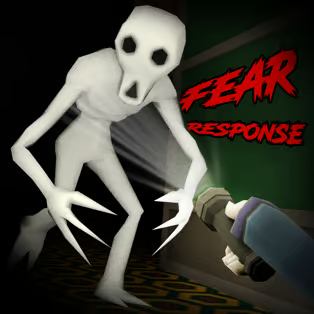
Fear Response is a 3D horror investigation game that puts you in the role of Harry, a member of the Fear Response Team sent to examine the ruins of an old manor house. A couple and their young daughter Cheryl once lived here. No one knows where they are now. What you find in the manor's halls — what still moves through them, what the puzzles and rooms reveal about what happened — is what the game is built around delivering.
The investigation structure gives Fear Response a different texture from purely reactive horror games. You are here to find out something specific: what happened to a family in a specific house. The puzzles embedded in the manor's layout and the environmental storytelling woven through its rooms are the mechanism through which that story emerges. Getting to the exit alive requires solving the manor's mysteries rather than simply surviving long enough to find the door.
The manor itself is the game's primary character — a 3D space whose crumbling architecture, abandoned rooms, and unsettling details are all telling a story that Harry has been sent to understand. Whatever still haunts its halls is a product of what happened to the family, and that connection between the horror and the history is what elevates the investigation above standard haunted-house gameplay.
Can you find out what happened to the family? Can you get out after you do?
Key Details
| Genre | 3D Horror Investigation / Puzzle |
| Difficulty Level | Medium |
| Average Play Time | 20–40 minutes |
| Best For | Story-driven horror fans, investigation and mystery players, and anyone drawn to horror games where understanding what happened is as important as surviving it |
How to Play Fear Response
Getting Started
- Survey the manor before engaging with any specific puzzle — the house contains multiple interconnected rooms and halls, and understanding the general layout before committing to any particular investigation direction prevents the backtracking that wastes time in the later, more pressured sections.
- Interact with everything suspicious — the mouse handles all interactions in the game. Click on objects, examine surfaces, and engage with anything that might be relevant to understanding what happened to the family. Clues are embedded in the environment rather than announced.
- Work through the manor's puzzles systematically — puzzle solutions in Fear Response are grounded in the environmental logic of the house. Clues found in one room frequently apply to puzzles in another — maintain awareness of everything discovered rather than treating each room as an isolated challenge.
- Navigate the halls carefully — whatever still haunts the manor requires careful movement through its corridors. Use the WASD or arrow keys to move through the house and the mouse to interact with its contents, staying alert to what each new room reveals and what it might contain.
- Find the exit — the ultimate goal is escape. The path to it runs through the manor's puzzles and the story they tell. Understanding what happened to the family may be the key to getting out.
Basic Controls
| Input | Action |
|---|---|
| WASD / Arrow Keys | Move through the manor |
| Mouse | Look around, aim, and perform all in-game actions |
| Left Mouse Button | Interact with objects, examine clues, trigger puzzle elements |
| Mouse Movement | Control camera direction and survey the environment |
Objective
Investigate the ruins of the old manor as Harry, uncovering what happened to the family — a couple and their daughter Cheryl — who once lived there. Solve the puzzles embedded throughout the house, navigate its haunted halls, and find the exit before whatever remains in the manor prevents you from leaving.
Fear Response Features & Highlights
- Mystery-driven investigation structure — a specific family's disappearance is the narrative engine of the game, giving the horror a human story that the puzzle-solving progressively reveals
- 3D manor environment — a fully realized crumbling manor with multiple interconnected rooms and halls, each contributing to the environmental story of what happened here
- Environmental storytelling — the horror and the history of the house are delivered through the manor's physical details rather than explicit exposition, rewarding thorough investigation
- Puzzle-centered progression — escape requires understanding the house, not just surviving it — puzzles unlock the path forward and the story simultaneously
- Free and unblocked online play — immediately accessible through modern browsers without download, payment, or registration
Fear Response Tips & Strategies
Beginner Tips
- Examine every room completely before moving to the next. The manor's investigation structure means that a clue in one room is frequently the solution to a puzzle in another. Players who move through rooms quickly without fully examining their contents find themselves backtracking repeatedly when puzzle solutions don't materialize. Complete searches before moving on.
- Click on everything that appears interactive, even if its relevance isn't immediately clear. Environmental clues in Fear Response don't always announce their importance at first glance. An object that seems like set dressing may become significant later. Interact broadly and let the game's logic surface the relevance rather than pre-filtering what seems worth examining.
- Remember what you've found as you move through the manor. The house is a connected space rather than a series of isolated rooms, and puzzle solutions frequently emerge from combining context gathered in different locations. Keeping a mental (or physical) note of significant discoveries prevents the situation where you have the answer but can't remember where the question was.
Advanced Strategies
- Work backward from puzzle locks to find their corresponding clues. When a puzzle mechanism is encountered, note its specific requirements — the type of input it's looking for, the visual language it uses — and move through the manor looking specifically for elements that match. This targeted search is more efficient than comprehensive room re-examination when the manor has already been broadly surveyed.
- Pay attention to the family's story as a puzzle hint system. The narrative details of what happened to the family — the couple, young Cheryl, the sequence of events the manor's evidence suggests — frequently contain implicit hints about the puzzle solutions the house contains. The history and the puzzles are connected by design; understanding one helps with the other.
What to Watch Out For
- Moving through the manor too quickly when something is following you. The manor's haunting presence demands attention to what's behind you as well as what's ahead. Fast movement through corridors without checking the direction you came from is a consistent cause of unexpected encounters. Move with purpose but not recklessness.
- Ignoring the manor's atmospheric details in favor of purely mechanical progress. The ruined house's environmental storytelling is where the family's story lives. Players who treat every room as a puzzle container rather than a narrative space miss the context that makes the game's conclusion meaningful rather than arbitrary.
Fear Response Elements Explained
Investigation & Environmental Storytelling
The investigation structure of Fear Response is what separates it from standard haunted-house horror games. Harry's mission is specific — find out what happened to a family, not just escape a scary building — and the manor's contents are organized around delivering that answer through environmental evidence rather than cutscenes or explicit narrative delivery.
Every room in the manor contains details that contribute to the family's story: the personal effects of people who lived here, the evidence of specific events, the indications of a sequence that ended badly. Reading these details — not just interacting with puzzle-relevant objects but actually absorbing the environmental storytelling embedded in the space — builds a picture of the family's final days that the game's conclusion makes use of.
The couple and their daughter Cheryl are present throughout the manor in this indirect way before they're directly relevant to the game's resolution. Understanding who they were and what the house means is preparation for what Harry finds at the game's climax, and players who engaged with the investigation rather than rushing through the puzzles arrive at that climax with significantly more emotional context for what it means.
Puzzle System
The manor's puzzle system is the mechanical layer through which both progression and story are delivered simultaneously. Puzzles lock doors, block paths, and guard the information Harry needs — and solving them requires the environmental awareness that the investigation structure rewards. Clues gathered from one section of the manor apply to puzzles in another, making the house a connected information space rather than a series of isolated mini-games.
The puzzle design is grounded in the manor's internal logic rather than abstract challenge for its own sake. Solutions make sense within the context of the house and the family that lived in it — the kinds of locks, codes, and mechanisms a real family might have used, in a space that reflects their specific history. This grounding makes puzzle-solving feel like investigation rather than obstacle-clearing, which is the experience the game is built around delivering.
When a puzzle resists solution, the answer is almost always in a room that hasn't been fully examined rather than an unintuitive logical leap. The manor contains everything Harry needs — the challenge is finding it through thorough investigation rather than clever guessing.
The Manor Environment
The manor itself — its specific architecture, its state of decay, its individual rooms and the details within them — is the game's central character in a way that goes beyond standard horror game level design. This was a specific family's home, and the house reflects that specificity: rooms that were once lived in, spaces that tell stories through their contents and their current condition, halls that connect areas in ways that reveal something about how the family moved through their home.
The haunting that currently inhabits the manor is a consequence of what happened to the family rather than an independent supernatural presence, and the connection between the two — the history and the horror — is embedded in the physical space. Players who investigate thoroughly enough discover that understanding one is the key to understanding the other, and that the exit Harry is trying to reach isn't just a physical door but a resolution of what the manor is holding onto.
Fear Response Frequently Asked Questions
Q: How do I interact with objects in the manor?
A: All interactions in Fear Response are mouse-controlled. Move Harry near an object of interest using WASD or arrow keys, then click with the mouse to examine, pick up, or interact with it. The game uses the mouse for all in-game actions — look around by moving the mouse, and click to engage with anything that appears interactive in the environment.
Q: What should I do when I'm stuck on a puzzle?
A: Return to rooms you've visited and examine any objects or surfaces you haven't fully interacted with. Puzzle solutions in the manor are almost always present in the environment — the issue is usually a clue that was overlooked rather than a leap of logic that hasn't been made. If a specific room's puzzle isn't yielding to your current information, explore more of the manor before returning to it — the relevant clue may be in an area you haven't reached yet.
Q: Is this game compatible with all browsers and devices?
A: Fear Response is a free, unblocked online game designed for modern desktop browsers. Chrome and Firefox on a current desktop or laptop provide the best performance. The game uses mouse and keyboard controls (WASD/Arrow Keys for movement, mouse for all interactions), making touchscreen devices less suitable for precise investigation actions. No download, payment, or registration is required to play.
Q: Can I save my progress during the investigation?
A: Fear Response is designed as a single-session experience given its relatively compact runtime of 20–40 minutes. Mid-session saving may not be available — completing the investigation in one sitting is the intended play structure. If the session is interrupted, progress may need to be restarted from the beginning of Harry's investigation.
Q: What happened to the family — is the answer clear by the end?
A: The family's story — what happened to the couple and to Cheryl — is the game's central mystery and its narrative payoff. The answer emerges through the investigation itself: the clues, the environmental details, the puzzles that unlock deeper areas of the manor all contribute to a picture that becomes clear by the time Harry reaches the exit. Players who engaged thoroughly with the investigation arrive at that answer with full context; those who rushed through the puzzles may find the conclusion less complete.
Games Like Fear Response You Might Enjoy
If you like Fear Response, you might also enjoy:
- Overnight Interview - it leans into eerie story clues, confined spaces, and slow-burn horror discovery.
- The Coffin of Andy and Leyley - it leans into eerie story clues, confined spaces, and slow-burn horror discovery.
- Human Expenditure Program - it leans into eerie story clues, confined spaces, and slow-burn horror discovery.