







FNAF Free 4 Overview
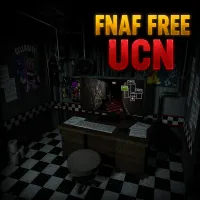
FNAF Free 4 does something audacious for a Five Nights at Freddy's game: it takes away the cameras entirely. No feeds to monitor, no network to manage, no birds-eye view of the building to give you a sense of where the threats are. Instead, you're locked in a bedroom, in first person, with nothing but the sounds coming through the walls and the dim beam of a flashlight to tell you what's happening outside.
The result is a survival experience built almost entirely on audio awareness and timing discipline. You cannot see what's coming. You can only listen — to footsteps, to breathing, to the subtle shifts in ambient sound that signal something is near a hallway entrance or inside the closet door. Then you have to act, and act precisely, with tools that punish even slightly wrong timing.
This is where Free 4's design becomes genuinely interesting. The bedroom gives you four directions to monitor: left hallway, right hallway, closet ahead, and the bed behind you. Each can become a threat vector. You turn, check, listen, decide — close a door or use the flashlight — then turn again. It's a loop that sounds simple but becomes increasingly demanding as nights progress and the window between hearing a cue and needing to respond shrinks to near-nothing.
Free 4 is the FNAF entry for players who find camera management too removed from the action and want something that puts them directly inside the horror rather than managing it from a distance. It's intimate, immersive, and relentlessly good at building the specific kind of dread that comes from not knowing exactly what you're dealing with until it's almost too late.
Key Details
| | | |---|---| | Genre | Survival Horror / First-Person Reflex | | Difficulty Level | Medium to Hard — escalates sharply across nights | | Average Play Time | 10–20 minutes per night | | Best For | Immersive horror fans, players who prefer audio-based gameplay, FNAF fans seeking a more intimate and claustrophobic survival experience |
How to Play FNAF Free 4
Getting Started
1. Begin each night inside the bedroom in first-person view — take a moment to orient yourself to the four threat directions before the night gets active. 2. Rotate your view regularly between the left hallway, right hallway, closet, and the area behind you near the bed to monitor all potential threat vectors. 3. Listen carefully to ambient sound — changes in audio signal that something is approaching a specific direction before it becomes visible. 4. When you hear movement in a hallway, close the corresponding door immediately using Shift to block the threat. 5. Use the flashlight (Ctrl) to illuminate and check specific areas when audio cues are ambiguous — but use it judiciously, as flashlight use must be timed correctly to be effective.
Basic Controls
- Mouse — Look left, right, forward, and behind to monitor all four directions
- Click — Interact with doors and surrounding environmental elements
- Hold Shift — Close doors when a threat is detected in a hallway
- Press Ctrl — Activate flashlight to illuminate and check specific areas
Objective
Survive each night inside the bedroom by monitoring four threat directions through audio awareness and precise tool use. Close doors when threats approach hallways and use the flashlight to check ambiguous areas. Survive until morning across all nights, reacting faster and more accurately as the timing windows tighten with each passing night.
FNAF Free 4 Features & Highlights
- Audio-first gameplay — Sound cues replace camera feeds as the primary threat detection system, creating a more intimate and immersive survival experience
- First-person bedroom perspective — The claustrophobic single-room setting intensifies the horror compared to the relative safety of a security office with camera access
- Four-directional threat monitoring — Left hallway, right hallway, closet, and behind the bed each present independent threat vectors requiring regular attention
- Precision timing mechanics — Flashlight use and door closing must be deployed at exactly the right moment — too early or too late changes the outcome entirely
- Escalating night difficulty — Timing windows shrink and threat frequency increases with each night, demanding genuine improvement in reaction speed and audio processing
FNAF Free 4 Tips & Strategies
Beginner Tips
- Establish a consistent rotation pattern across your four directions from the start — left, closet, right, behind. Skipping a direction, even once, is often when threats find an opening.
- Trust your audio cues before you visually confirm. By the time something is visible in a doorway, the timing window for an effective response is already narrowing. React to sounds, not sights.
- Resist the urge to hold the flashlight on indefinitely when checking an area. A quick flash-and-check is more efficient than prolonged illumination, and it preserves your reaction readiness for other directions.
Advanced Strategies
- On harder nights, prioritize audio cue recognition over visual confirmation for every threat. Developing the ability to categorize a sound by direction and urgency — without needing to look — is what allows you to maintain rotational coverage even under pressure.
- The closet and behind-the-bed directions are the most neglected by most players. Build a strong habit of checking them on every rotation cycle, not just when something else feels quiet.
- If you're consistently failing on a specific night, identify whether the problem is reaction delay (you're responding correctly but too slowly) or incorrect reads (you're responding to the wrong cues). These require different solutions — speed training versus audio pattern study.
What to Watch Out For
- Fixating on one direction too long — Spending extra time checking a hallway that just triggered a scare leaves the other three directions unchecked. Set a hard mental limit on how long you look in any one direction before rotating.
- Closing doors preemptively — Closing a door too early can trap you without access to that direction for longer than necessary. Wait for a clear audio cue before committing to a close, rather than reacting to ambient atmosphere alone.
FNAF Free 4 Elements Explained
Audio Detection System
In the absence of cameras, audio is your entire threat intelligence network. Different sounds — footsteps, breathing patterns, ambient shifts, and specific cue tones — correspond to specific threat types and locations. Learning to decode this audio landscape is the foundational skill of FNAF Free 4. Early sessions will feel like noise; experienced players hear the same sounds as a clear map of what's approaching and from which direction. The audio system rewards players who approach it analytically: after each failed run, identifying which sound preceded the fatal encounter and internalizing what response it requires transforms the game from overwhelming to manageable. The system never cheats — every threat is telegraphed through audio before it arrives. The question is whether you've learned to read the signals fast enough.
Four-Direction Monitoring
The bedroom's four threat directions — left hallway, right hallway, closet ahead, and behind the bed — operate as independent monitoring channels that all require regular attention. Unlike camera-based FNAF entries where you have a network of feeds to cycle through, here the "camera switching" is physical: you turn your view. This creates a rotation discipline challenge that increases in demand as nights progress. Each direction can become active at any time, and there's no safe priority order that makes any direction permanently ignorable. The most effective players develop a consistent rotation rhythm — scanning all four on a reliable cycle — that prevents any single direction from going unchecked long enough for a threat to advance uncontested.
Precision Tool Timing
Free 4's two active tools — the flashlight and the door-closing mechanic — are both timing-dependent in ways that penalize imprecision. The flashlight illuminates whatever direction you're facing and is most effective when deployed at the exact moment a threat is at a specific position in its approach. Too early and you illuminate an empty space; too late and the threat has already advanced past the point where light affects its behavior. Door closing requires similar precision — the door must be shut while a threat is in the hallway, not before it arrives (wasted) or after it's already entered (fatal). Developing accurate timing for both tools is the mechanical skill that determines whether your audio awareness translates into actual survival, or whether you read the situation correctly but respond too imprecisely to capitalize on it.
FNAF Free 4 Frequently Asked Questions
Q: How do I know when to close a door?
A: Listen for audio cues indicating movement in a specific hallway direction before closing the corresponding door. Close the door when you hear the approach cue — not before, which wastes the opportunity to keep the direction observable, and not after the threat has already moved past the doorway. Practice matching specific sounds to the correct timing window across multiple sessions.
Q: What should I do if I can't tell which direction a sound is coming from?
A: Prioritize your rotation — cycle through all four directions quickly to visually confirm which is active. If a sound is genuinely ambiguous, default to checking the closet and behind-the-bed directions first, as these are the most commonly neglected by players and the most likely to be overlooked during periods of confusion.
Q: Is FNAF Free 4 compatible with standard browsers?
A: The game is designed for desktop browser play. Use an updated modern browser with hardware acceleration enabled. Critically: play with headphones or good external speakers if possible — the audio detection system is the game's primary mechanic, and poor audio quality or low volume significantly degrades your ability to read threat cues accurately.
Q: Can I save progress between nights?
A: Night progress is saved between sessions, allowing you to resume from your most recently completed night rather than restarting from Night 1. Individual nights must be completed in a single sitting — exiting mid-night will require you to replay that night from its beginning.
Q: How do I use the flashlight effectively?
A: Press Ctrl to activate the flashlight briefly while facing the direction you want to illuminate. Use it to confirm ambiguous audio cues rather than as a constant light source — quick, targeted flashes while maintaining your rotation cycle are more effective than prolonged illumination of a single area. On later nights, precise flashlight timing becomes essential; practice short controlled bursts rather than holding the light on indefinitely.
Games Like FNAF Free 4 You Might Enjoy
If you like FNAF Free 4, you might also enjoy:
- Five Nights at Freddy's 4 - it shares the same animatronic pressure, survival timing, and quick browser play rhythm.
- FNAF Shooter - it shares the same animatronic pressure, survival timing, and quick browser play rhythm.
- FNAF Strike - it shares the same animatronic pressure, survival timing, and quick browser play rhythm.