One Night at Flumptys Overview
An egg kidnapped you. It finds this funny. You will not.
One Night at Flumpty's is a FNAF-inspired survival horror game with a cast of characters so bizarre and unsettling that they've developed their own dedicated fanbase entirely separate from the franchise that inspired them. Flumpty Bumpty — an egg with the ability to travel through time and space who kills people for no particular reason — has decided you're his next playmate. He's brought you to an abandoned house and proposed a simple game: survive until 6 a.m.
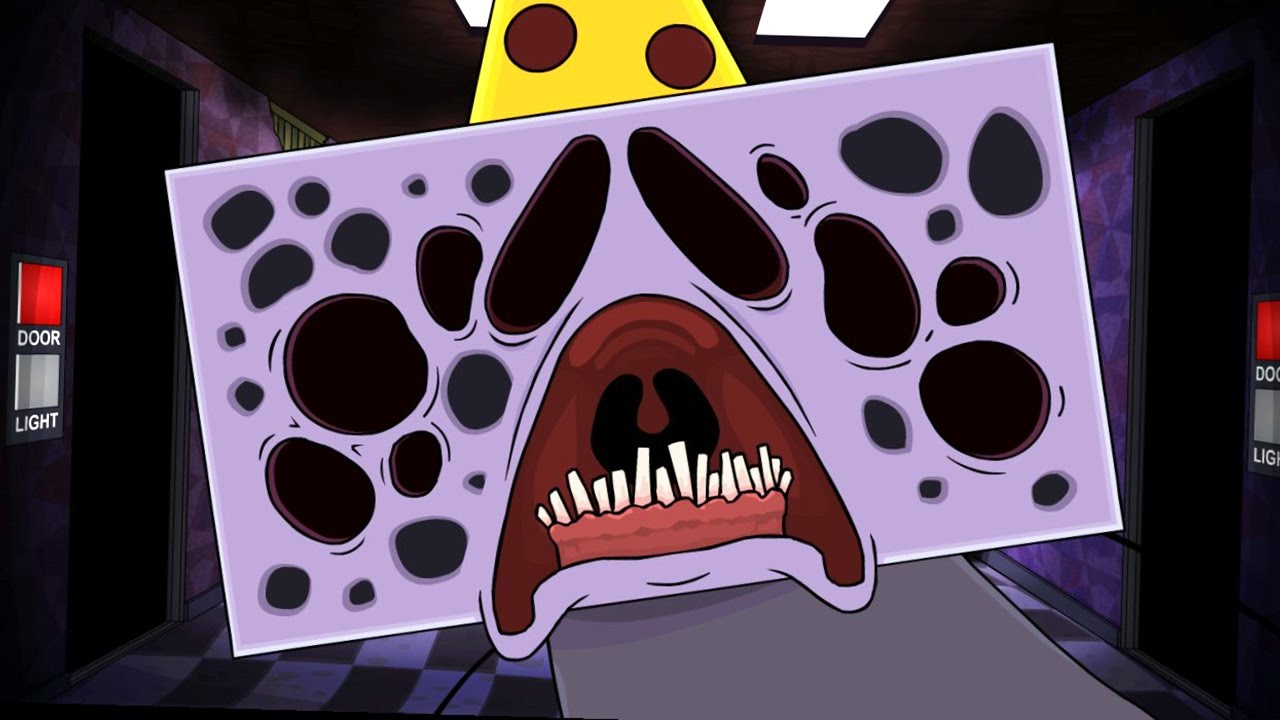
The game takes the core FNAF formula — one night, one room, multiple threats, cameras and doors as your only defenses — and fills it with a roster of characters that are genuinely, specifically strange. Not frightening in a conventional horror way, but wrong in a way that's harder to shake. A murderous egg. A small square that likes pizza and comes through windows. A clown that lives in a toilet and attacks you if you look at him too long. A red face that doesn't kill you — it just gets in the way. These are not generic horror archetypes. They are inexplicable, and their inexplicability is precisely what makes them work.
Mechanically, the game demands the same multi-threat awareness and resource discipline as the best of the FNAF genre. Each character has a distinct behavioral pattern and requires a different response to manage, and all of them can be active simultaneously. Camera monitoring, door management, and light usage must all be balanced against each other with the power limitations of the building keeping every decision a trade-off.
One night. Six a.m. Flumpty wants to play. Survive.
Key Details
| Genre | Survival Horror / FNAF-Style |
| Difficulty Level | Hard |
| Average Play Time | 10–20 minutes per attempt |
| Best For | FNAF fans seeking a fresh and uniquely bizarre take on the formula, horror players drawn to character-driven survival challenges, and anyone curious what it means to be hunted by a time-traveling egg |
How to Play One Night at Flumptys
Getting Started
- Access the surveillance cameras immediately — your camera system is the primary tool for tracking character movements throughout the abandoned house. Establish each character's starting position in the first minutes of the night before they begin moving.
- Learn each character's approach route — different characters enter your room through different paths. Birthday Boy Blam comes through the window; The Beaver & The Owl move through passages and can only be stopped by closing doors. Knowing which direction each threat comes from shapes all your defensive decisions.
- Monitor Flumpty's position as your first priority — Flumpty follows no rules and can appear anywhere in the house at any time. He requires constant camera attention rather than a predictable tracking routine. If you can't see him, assume he could be anywhere.
- Manage doors and lights in response to confirmed threats — close doors when The Beaver & The Owl are approaching through passages. Use lights to check blind spots outside your room for threats the cameras don't cover. Both actions cost power — use them in response to confirmed or suspected threats, not preemptively.
- Never stare at Grunkfuss — if the camera shows Grunkfuss the Clown, check his position briefly and move to another feed. Extended viewing of Grunkfuss triggers his attack. Confirm his location with a quick look and cut away.
Basic Controls
| Input | Action |
|---|---|
| Mouse Click | Operate cameras, doors, and lights |
| Camera Feed Navigation | Switch between surveillance feeds to track characters |
| Left Door Button | Close the left door to block approaching threats |
| Right Door Button | Close the right door to block approaching threats |
| Left Light Button | Illuminate the left hallway to check for threats |
| Right Light Button | Illuminate the right hallway to check for threats |
| Power Monitor | Track remaining power — all actions drain the supply |
Objective
Survive from the start of the night until 6 a.m. in the abandoned house, monitoring the camera system to track Flumpty Bumpty and his friends while managing door and light defenses to prevent them from reaching your room. Every action drains your limited power supply — balance defensive use with conservation to avoid losing power before dawn.
One Night at Flumptys Features & Highlights
- Wholly original character roster — Flumpty Bumpty and his friends are entirely unique creations with distinct visual identities and behavioral mechanics unlike anything else in the FNAF genre
- Six distinct threats with individual behaviors — each character requires a different management approach, from camera tracking to door closures to deliberate non-staring, creating a multi-threat puzzle with no single universal solution
- Classic FNAF survival structure with fresh personality — the camera-doors-lights power management formula is faithfully present and mechanically sharp, carrying a cast and atmosphere entirely its own
- Extreme character specificity — the game's humor and horror operate simultaneously through characters so precisely strange — a toilet clown, a square that loves pizza, a red face that just blocks things — that they generate dread through sheer wrongness
- High-intensity single-night structure — one night, one room, everything at stake — the compact format delivers maximum tension without the multi-night progression structure of longer FNAF entries
One Night at Flumptys Tips & Strategies
Beginner Tips
- Treat Flumpty as your constant unknown. Every other character has a behavior pattern and a route you can learn. Flumpty has neither — he can appear anywhere, at any time, and doesn't follow rules. Your camera rotation should always include a Flumpty check, and the absence of a confirmed sighting is not safety. It just means you don't know where he is yet.
- Close doors only when a threat is confirmed approaching, not preemptively. Doors cost power every second they stay closed. Closing both doors simultaneously as a precaution drains your supply faster than almost any other mistake. Close a specific door in response to a specific confirmed threat, then reopen as soon as the threat passes.
- Cut away from Grunkfuss immediately after locating him. The camera feed that shows Grunkfuss the Clown is a necessary check — you need to know where he is. But the check must be brief. Locate him, confirm his position, and immediately switch to another feed. Every extra second looking at Grunkfuss is a second closer to triggering his attack.
Advanced Strategies
- Develop a camera rotation that accounts for Flumpty's unpredictability. Against every other character, efficient camera use means checking their known routes and approach paths on a schedule. Against Flumpty, efficient camera use means sweeping every available feed regularly, with no assumptions about where he'll be based on where he was. Build the Flumpty sweep into every rotation cycle rather than treating him as a secondary check.
- Use The Redman's obstruction as an early warning signal. Redman doesn't attack — but his habit of blocking cameras and lights means that when visibility in a specific area suddenly drops, Redman is likely there. Rather than treating this as pure irritation, use the obstruction as directional information: something significant may be happening in the zone he's interfering with.
What to Watch Out For
- Birthday Boy Blam approaching through the window unnoticed. Blam moves through the window rather than a door, which means standard door management doesn't apply to him. Check the window-facing camera feeds specifically for his approach rather than assuming door coverage handles all character threats. Missing his approach while focused on door-based threats is a common mid-run death cause.
- Power depletion from light overuse. Lights are useful for checking hallways the cameras don't fully cover, but new players often use them as a constant supplement to camera monitoring rather than a targeted check tool. Lights left on continuously drain power as steadily as closed doors. Use them for specific blind spot checks and turn them off immediately after.
One Night at Flumptys Elements Explained
Character Behaviors & Individual Mechanics
The six characters in One Night at Flumpty's are the game's core design achievement — each mechanically distinct in ways that require genuinely different player responses, creating a multi-threat management puzzle where no single defensive strategy addresses all simultaneous dangers.
Flumpty Bumpty is the primary threat and the game's defining mechanical challenge. Unlike every other character, he follows no rules and is subject to no predictable patrol pattern. He can appear in any camera feed at any moment without telegraphing his movement. Managing him means constant camera vigilance without the comfort of knowing where to look — his presence in any feed is an immediate priority alarm, and his absence from all visible feeds is not safety, just uncertainty.
Birthday Boy Blam approaches through the window on a determined path, making him a consistent directional threat whose approach is monitorable but must be caught early. Missing his window approach while focused on door-relevant threats is a significant run-ender for players who don't build window feed checks into their camera rotation.
The Beaver & The Owl move through the house's passages and can only be stopped by closing the relevant door before they complete their approach. They are the most straightforwardly manageable of the character roster — predictable route, clear response — but their presence in multiple passages simultaneously can force door use that compounds power expenditure.
The Redman is the game's interference character — he doesn't attack, but he blocks cameras and lights, degrading your visibility in specific zones. His presence should be read as information rather than pure obstruction: the area he's interfering with likely warrants attention to whatever might be happening behind the blocked view.
Grunkfuss the Clown requires the most actively unusual response of any character: look at him to confirm location, then immediately stop looking. Extended camera time on Grunkfuss is the trigger for his attack — a mechanic that inverts the usual "more information is better" logic of camera management and demands disciplined brevity in a game that otherwise rewards sustained attention.
Camera & Power Management System
The camera and power management system is the mechanical backbone of the full night in One Night at Flumpty's. A fixed power supply governs every active defensive action — cameras consume power while active, doors drain power every second they remain closed, and lights draw from the same supply whenever switched on. The power indicator shows a dwindling resource with no means of replenishment, and reaching zero before 6 a.m. leaves you defenseless against whatever is currently in the house.
Effective power management is fundamentally a prioritization problem. With six characters active throughout the night and multiple systems competing for the same finite resource, every decision to use one defensive tool is implicitly a decision to have less power available for every other tool. A door closed unnecessarily for thirty seconds is thirty seconds of power not available for cameras tracking Flumpty, lights checking a blind spot, or another door closure when an actual threat arrives.
The camera system's individual feeds each cover specific areas of the house, and building a rotation that covers the highest-risk areas most frequently — while accounting for Flumpty's unpredictable omnidirectionality and Grunkfuss's brief-look-only requirement — is the repeating optimization challenge that experienced players solve differently every run based on where characters are showing up.
Abandoned House Environment
The abandoned house is not a neutral setting — it is an active participant in the game's tension architecture. Its layout determines which camera feeds cover which approach routes, which doors correspond to which passages, and where characters tend to emerge from as they make their way toward your room. Understanding the house's geography is a prerequisite for defensive efficiency.
The room you occupy throughout the night has two door access points and two light-illuminated hallways, plus window exposure that Birthday Boy Blam uses as his exclusive approach route. The camera feeds distributed through the house give you partial visibility into the spaces beyond these entry points, but coverage has gaps — particularly in areas The Redman can interfere with — that mean the camera system never provides complete information.
The house's abandoned condition contributes to the atmosphere in ways that extend beyond visual design. The sense that this is a space that has been repurposed for something it was never intended for — a child's game of survival horror organized by a time-traveling egg — pervades every room's feeling. The house doesn't feel haunted in a traditional sense. It feels chosen, which is somehow worse.
One Night at Flumptys Frequently Asked Questions
Q: How do I track Flumpty if he can appear anywhere?
A: Flumpty cannot be tracked through predictive route monitoring the way other characters can — he has none. The only way to track him is to include every available camera feed in your regular rotation and check each one frequently enough that his position is never unknown for more than a few seconds. If he appears in a feed close to your room, treat it as an immediate high-alert situation. If he's not visible in any feed, assume he's about to be visible in one that matters — not that he's safely elsewhere.
Q: How long should I look at Grunkfuss when I find him on camera?
A: As briefly as possible — confirm his position and move to the next feed immediately. There is no safe extended viewing window with Grunkfuss. The check should take approximately the time required to register where in the frame he is, then cut away. Any further time spent on his feed is risk without additional useful information. Consider Grunkfuss feeds a single-glance information stop rather than a monitoring position.
Q: Is this game compatible with all browsers and devices?
A: One Night at Flumpty's is designed for modern desktop browsers, with best performance on up-to-date Chrome or Firefox on a desktop or laptop. The game is fully mouse-driven, requiring no keyboard input, which makes it accessible on any system with a pointing device. Mobile browsers may have limited compatibility due to the interface layout and control precision requirements.
Q: Can I save progress mid-night?
A: One Night at Flumpty's is a single-session experience — one night from start to 6 a.m., with no save points during the run. If you fail, the night resets from the beginning. The short session length of 10–20 minutes per attempt makes this appropriate to the format. Each run is a complete, self-contained survival challenge.
Q: What does The Redman actually do, and how do I stop him?
A: The Redman doesn't attack you directly — his mechanic is interference rather than aggression. He can appear in front of cameras or lights, blocking your visibility in those areas. You cannot remove him through any active player action; he moves on his own schedule. The practical response is to read his blocking behavior as a signal: when a camera or light is suddenly obscured, note which area is affected and compensate by increasing attention to adjacent feeds that might reveal what's happening near the blocked zone. His irritation value is real, but he also inadvertently provides directional information about where in the house something worth obscuring may be occurring.
Games Like One Night at Flumptys You Might Enjoy
If you like One Night at Flumptys, you might also enjoy:
- FNAF 6 - it keeps the animatronic pressure, camera checks, and night-shift tension close to the same survival rhythm.
- FNAF 6 Plus - it keeps the animatronic pressure, camera checks, and night-shift tension close to the same survival rhythm.