







Backroom Game Overview
You weren't supposed to find that door. And now you can't find your way back.
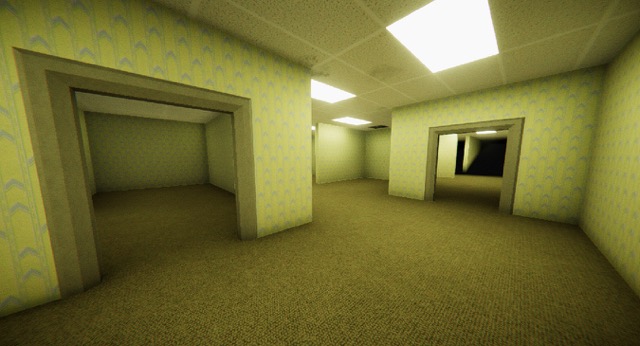
Backroom Game is a survival horror escape game inspired by the Backrooms — the internet's most unnerving piece of collaborative horror lore. The premise is deceptively simple: you've slipped through a hidden door into an abandoned structure of endless rooms and corridors, all painted the same pale yellow, all carpeted with the same damp, yellowing rugs. No exits are visible. No other people are present. Something, however, is.
The Backrooms mythology captures a very specific kind of dread — the wrongness of a space that shouldn't exist, familiar enough to recognize as a building but alien enough to feel fundamentally off. Backroom Game translates this atmosphere into nine distinct levels, each with its own layout, challenges, and escalating difficulty. What begins as disoriented wandering through empty corridors becomes increasingly tense as the building reveals it is not as empty as it first appeared.
Survival here is a multi-layered challenge. You need to move efficiently enough to outpace a ticking life clock, puzzle-solve using notes and artifacts scattered through the rooms, manage your equipment without wasting resources, and keep a close enough eye on your watch that the building's particular brand of madness doesn't claim you before the creatures do. Getting out requires all of these things working together — and the building is designed to make each one feel just slightly harder than it should be.
Equal parts exploration, puzzle, and survival horror, Backroom Game is the authentic Backrooms experience for players who want their abandonment anxieties fully realized.
Key Details
| Genre | Survival Horror / Escape Room |
| Difficulty Level | Variable (scales across nine levels) |
| Average Play Time | 20–45 minutes per run |
| Best For | Backrooms lore fans, survival horror players, escape room enthusiasts, and anyone drawn to atmospheric exploration games with genuine tension |
How to Play Backroom Game
Getting Started
- Choose your mode — select between Story mode for a structured narrative experience or Survival mode for a purer endurance challenge before entering the building. Understanding which mode you're in shapes how you approach exploration and resource use.
- Orient yourself immediately — when you enter a new level, pause and take in the immediate environment before moving. Note the corridor layout, any visible objects, and the general structure of the space around you. Backrooms levels are deliberately disorienting — establishing a mental map early is essential.
- Search every room systematically — notes, artifacts, and clues are distributed throughout each level. These items solve puzzles and provide critical information about the creatures you'll encounter. Search rooms thoroughly before moving on rather than rushing toward an exit you haven't located yet.
- Check your watch every 30 seconds — your sanity and survival are tied to regular watch checks. Neglecting this causes disorientation effects that compound into losing control of your character or becoming permanently trapped. Make it a habit, not an afterthought.
- Listen before moving into new areas — audio cues signal the presence and proximity of creatures before you encounter them visually. Hearing loud or unexpected sounds is a clear directive to stop, turn around, and find another route.
Basic Controls
| Input | Action |
|---|---|
| WASD / Arrow Keys | Move through corridors and rooms |
| Mouse | Look around / control camera |
| E | Interact with objects, pick up items, examine notes |
| Run Key (Shift) | Sprint (use sparingly — drains time) |
| Watch (UI) | Check every 30 seconds to maintain sanity |
| Inventory (UI) | Manage collected items, artifacts, and tools |
| Weapon / Item Use | Defend against or outwit creatures |
Objective
Escape the Backrooms building before your life meter expires or a creature claims you. Navigate nine levels of escalating difficulty, each with its own layout and challenges. Collect notes, artifacts, and clues to solve puzzles that unlock exits and reveal information about the building's creatures. Check your watch regularly to maintain sanity. Find the way out of each level to progress — and ultimately escape the building entirely.
Backroom Game Features & Highlights
- Nine distinct levels — each level has a unique layout, difficulty, and set of challenges, ensuring the game's exploration and escalating dread never feel repetitive across the full playthrough
- Authentic Backrooms atmosphere — the pale yellow corridors, damp carpet, and endless identical rooms faithfully recreate the specific existential unease of the internet's most famous horror mythology
- Multiple game modes — Story mode delivers a structured narrative arc while Survival mode offers a purer endurance challenge, giving players meaningful choice in how they engage with the content
- Hidden rooms and secret exits — the building rewards thorough exploration with concealed spaces and alternative escape routes that casual players will miss entirely
- Sanity and watch mechanic — a unique time-check system ties your mental state to regular watch monitoring, adding a layer of active management absent from most survival horror games
Backroom Game Tips & Strategies
Beginner Tips
- Run as a last resort, not a first response. The sprint function is available, but using it depletes your limited time faster than walking. Running when frightened feels instinctive but is frequently counterproductive — deliberate, cautious movement conserves time and keeps you oriented in a layout designed to confuse.
- Read every note completely before moving on. Notes in each level contain puzzle solutions, creature behavioral clues, and environmental information. Players who skim or skip notes find themselves stuck on puzzles that the notes would have solved immediately, wasting significantly more time backtracking than careful reading would have cost.
- Set a real-world reminder for the watch mechanic if needed. The 30-second watch check is easy to forget in tense exploration moments. Missing multiple checks in succession causes disorientation effects that are genuinely difficult to recover from. Until the habit is internalized, treating it as a priority even during active creature encounters is safer than letting it slide.
Advanced Strategies
- Map the level mentally before committing to a direction. Backrooms levels are labyrinthine by design. Before pushing deep into any corridor cluster, build a rough mental model of how the spaces connect — which corridors loop, which lead to dead ends, and where the largest unexplored sections remain. This prevents the most common form of death in the game: running out of time while lost.
- Look for hidden rooms in every area you pass. The building's concealed spaces contain the most useful items and often house alternative exits that bypass creature-heavy routes. Players who only move through obvious corridors miss a significant portion of the game's content and leave themselves without options when primary exits are blocked.
What to Watch Out For
- Auditory complacency. The game's sound design is a survival tool, not just atmosphere. Players who stop actively listening for creature audio cues after surviving a few encounters are significantly more likely to walk into a dangerous situation without warning. Stay in the habit of pausing at corridor junctions to listen before proceeding.
- Resource waste from panic. Weapons and items available for defending against or outwitting creatures are finite. Using them reactively in moments of fear rather than strategically in necessary confrontations depletes resources that will be needed in later, harder levels. Assess before acting — most creatures can be avoided rather than fought if you have sufficient awareness of their position.
Backroom Game Elements Explained
Exploration & Puzzle System
The exploration and puzzle system is the core loop around which everything else in Backroom Game operates. Each of the nine levels hides its exit behind a combination of spatial navigation and puzzle-solving — you must find your way through the corridors, locate the relevant notes and artifacts, and apply that information to unlock the path forward.
The puzzle design reflects the Backrooms aesthetic: clues are embedded in the environment itself, scrawled on notes left by whoever came before you, or hidden in artifacts that require examination to yield their meaning. Nothing is labeled or obvious — the building does not want you to leave, and its puzzles reflect that hostility through deliberate obscurity.
Effective puzzle-solving in this game requires patience that runs counter to survival instinct. The urge to move quickly, to keep walking until an exit presents itself, actively works against the methodical room-by-room searching that puzzle solutions require. The players who escape fastest are typically those who slow down, search completely, and read thoroughly — not those who cover the most ground in the shortest time.
Sanity & Watch Mechanic
The watch mechanic is Backroom Game's most distinctive survival system and the one most frequently overlooked by new players until it costs them a run. Every 30 seconds of in-game time, checking your watch is required to maintain your character's sanity. Skipping checks allows disorientation to accumulate — visual and navigational effects that make the already-confusing building layout actively harder to parse. Extended neglect results in losing control of the character or becoming permanently trapped.
The mechanic is a direct expression of the Backrooms mythology. In the lore, the building's particular horror is its effect on the mind — the wrongness of the space is cumulative, and extended exposure without grounding anchors causes a specific kind of cognitive breakdown. The watch is your anchor, and checking it is how you remind yourself — and your character — that time is still passing and escape is still possible.
Managing this mechanic while simultaneously navigating corridors, avoiding creatures, and solving puzzles creates the game's most demanding moments. Creature encounters, in particular, are moments when the watch check is most easily forgotten and most consequential to miss. Building the habit early, before survival pressure peaks, is the most reliable way to prevent sanity from becoming the run-ender.
Creatures & Combat
The creatures inhabiting the Backrooms building are the building's most active threat — distinct from the passive, environmental dread of the corridors themselves. Each level introduces threats with their own behaviors and movement patterns, and the escalating difficulty across nine levels reflects increasingly complex and aggressive creature encounters.
Detection avoidance is the primary strategy. The game's audio cues give advance warning of creature proximity — footsteps, ambient sounds, and specific noises tied to individual creature types all signal presence before visual contact. Reacting to these cues by halting movement, identifying the sound's direction, and rerouting away from it bypasses the majority of dangerous encounters without requiring resource expenditure.
When avoidance isn't possible, collected weapons and items provide defensive and evasive options. These resources are finite and their allocation across nine levels matters — spending them freely in early levels leaves you under-equipped for the harder creature encounters in later ones. Every confrontation where a creature can be outwitted or avoided rather than fought directly is a conservation win that compounds over the full run.
Backroom Game Frequently Asked Questions
Q: How do I check my watch, and what happens if I forget?
A: Access your watch through the UI at regular intervals — the target is every 30 seconds of active play. Missing watch checks allows sanity degradation to accumulate, causing disorientation effects that make navigation harder and eventually result in losing control of your character or becoming permanently trapped in the building. If you notice the screen or controls behaving unusually, check the watch immediately and continue checking it more frequently until the effects subside.
Q: What should I do when I hear a loud noise nearby?
A: Stop moving immediately and listen to determine the direction of the sound. Do not advance toward it. Turn around and navigate away from the noise source, looking for an alternate corridor or room that routes around the creature's position. Hidden rooms can be valuable rerouting options in these situations — check walls in the area you're retreating through for concealed exits before committing to a longer detour.
Q: Is this game compatible with all browsers and devices?
A: Backroom Game is available in multiple versions, including a browser-based free version, mobile editions, and console releases. The browser version runs best on modern desktop browsers including Chrome and Firefox on an up-to-date desktop or laptop. Mobile versions are available for players preferring touchscreen play. Check the platform you're accessing for specific compatibility requirements and recommended specifications.
Q: Can I save my progress between levels?
A: Progress between completed levels may be retained depending on the version and platform you're playing on. The browser-based free version may reset progress if the tab is closed before completing a full session. Console and mobile versions typically include more robust save systems. Check the in-game menu for available save or checkpoint options before exiting a session.
Q: What is the difference between Story mode and Survival mode?
A: Story mode delivers the game's full narrative — structured level progression with lore context built into the note and artifact collection system, guiding players toward a complete understanding of the building and its creatures alongside the survival challenge. Survival mode strips the narrative framing and focuses entirely on endurance — how long can you survive, how far can you progress, and how efficiently can you manage resources and creature encounters without the story scaffolding. Both modes share the same nine levels and core mechanics; the difference is in framing and narrative delivery.
Games Like Backroom Game You Might Enjoy
If you like Backroom Game, you might also enjoy:
- Saw 4 Trapped Online - it offers another tense escape route built around puzzles, danger, and careful exploration.
- Cabin Horror - it offers another tense escape route built around puzzles, danger, and careful exploration.
- Portrait of an Obsession a Forgotten Hill Tale - it offers another tense escape route built around puzzles, danger, and careful exploration.