
Deltatraveler Overview
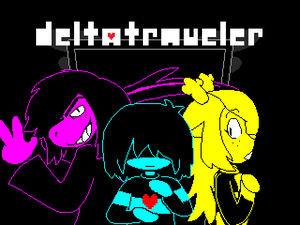
Deltatraveler is a fan-made 2D RPG that crosses the worlds of Deltarune and Earthbound, following Kris, Susie, and Noelle as they awaken inside unfamiliar universes connected by unstable grey doors. Each door opens a realm with its own logic, enemies, and puzzles — Undertale Ruins, Earthbound-inspired lands, and darker realms whose instability gradually reveals why these worlds are collapsing. The cross-universe storytelling is the game's most ambitious element, and it earns its weight through a design that makes each world feel distinct rather than cosmetically different.
The combat system builds on the bullet-dodging soul battles familiar to Deltarune fans but adds genuine party strategy through the interplay of Kris, Susie, and Noelle's distinct roles. TP management, positioning, and multi-phase boss fights that react to player choices make individual encounters meaningful rather than formulaic. Route decisions — whether to spare, fight, or exhaust enemies — carry consequence beyond dialogue tone, affecting difficulty spikes and final outcomes in ways that reward consistency over hedging.
Three primary routes structure the full experience: a pacifist path requiring consistent mercy across all encounters, a neutral path emerging from mixed choices, and an obliteration route that demands total enemy exhaustion while escalating difficulty and moral collapse in equal measure. The ending depends on cumulative behavior, not a single final choice.
Key Details
- Genre: 2D RPG / Fan Game / Bullet-Dodging Combat
- Difficulty Level: Medium–Hard (varies significantly by route)
- Average Play Time: 3–6 hours (full run)
- Best For: Deltarune and Undertale fans, RPG enthusiasts who enjoy moral consequence systems, players who appreciate cross-universe fan fiction done with craft
How to Play Deltatraveler
Getting Started
- Begin with Kris and party awakening inside an unfamiliar world — explore the environment for contextual clues about the universe's rules before engaging enemies.
- In combat, dodge enemy bullet patterns using Arrow Keys while positioning carefully relative to available actions.
- Select combat actions (fight, act, spare, use items) with Z or Enter, coordinating Kris, Susie, and Noelle's distinct capabilities across each encounter.
- Make route decisions consistently — sparing vs. fighting vs. exhausting enemies affects more than individual encounters.
- Solve environmental puzzles tied to each universe's specific logic to unlock paths, secrets, and optional confrontations.
Basic Controls
Move / dodge attacks: Arrow Keys
Confirm / interact: Z or Enter
Cancel / run: X or Shift
Open menu: C or Ctrl
Objective: Guide Kris, Susie, and Noelle through collapsing cross-universe worlds, solving environmental puzzles and managing combat through consistent route decisions that shape the story's direction and final ending.
Deltatraveler Features & Highlights
- Cross-universe storytelling — Deltarune characters navigate Undertale Ruins and Earthbound-inspired worlds, with heavy narrative consequences for each world's collapse
- Three distinct routes — pacifist, neutral, and obliteration paths produce meaningfully different story outcomes, difficulty profiles, and moral tones
- Party synergy combat — Kris, Susie, and Noelle's distinct abilities require genuine coordination across escalating multi-phase boss encounters
- Moral consequence system — spare, fight, and exhaust decisions affect dialogue tone, difficulty spikes, and final endings based on cumulative consistency
- Bullet-dodging soul battles — the Deltarune-inherited combat system demands active pattern-reading and positioning alongside turn-based strategic decisions
Deltatraveler Tips & Strategies
Beginner Tips
- Decide your intended route before entering the first world rather than mixing approaches — Deltatraveler's ending is determined by cumulative consistency, and mixed decisions tend to produce the least satisfying outcomes.
- In combat, prioritize TP management before maximizing damage output — TP fuels the abilities that carry party members through multi-phase boss encounters, and running dry in a second phase is the most common boss failure point.
- Environmental puzzles in each world are governed by that world's specific logic — cross-referencing visual and contextual clues within the same realm is more reliable than applying logic from previous worlds.
Advanced Strategies
- On the pacifist route, learning each enemy's ACT options before exhausting all fight options dramatically reduces encounter length and TP expenditure — some enemies spare immediately with the correct ACT sequence.
- The obliteration route's difficulty spikes are calibrated to punish underprepared parties — if you're committing to this path, prioritize Noelle's defensive capabilities during equipment decisions rather than maximizing Susie's offensive output.
- Optional confrontations accessible through puzzle completion often provide the game's most mechanically interesting encounters and its most significant narrative context for the world-collapse storyline.
What to Watch Out For
- Multi-phase boss encounters don't reset party HP or TP between phases — resource management across an entire boss fight, not just its opening phase, is the relevant planning horizon.
- Route consistency matters more than individual encounter outcomes; a single mercy in an otherwise obliteration run, or a single fight in an otherwise pacifist run, shifts the cumulative route tracker and may affect the available ending.
Deltatraveler Elements Explained
Cross-Universe World Design: Deltatraveler's world structure places Kris and party in sequential universes accessed through unstable grey doors, each with its own visual aesthetic, enemy roster, and environmental puzzle logic. The Undertale Ruins section draws on the spatial familiarity the Deltarune/Undertale audience brings to that environment while introducing new complications that reflect the world's instability. The Earthbound-influenced realms import that game's specific tonal blend of whimsy and underlying unease into a combat and exploration context calibrated for the party's capabilities. The darker realms that follow escalate both the narrative stakes and the mechanical demands, with enemy behaviors and puzzle structures that don't map cleanly onto either source game's conventions. The cross-universe premise justifies this variety while tying it to a coherent overarching question about why these worlds are collapsing.
Party Synergy & Combat System: Combat in Deltatraveler requires managing three characters with distinct roles rather than treating the party as an interchangeable damage pool. Kris, Susie, and Noelle each bring specific offensive, defensive, and support capabilities that complement each other most effectively when coordinated intentionally. TP, the resource that fuels non-basic actions, is shared across the party and regenerates through combat participation — depleting it early in a multi-phase encounter by prioritizing high-TP abilities leaves the party relying on basic actions precisely when enemy patterns become most demanding. Boss encounters are built around this resource tension: they're designed to outlast parties that spend freely and reward those that manage TP as a finite multi-phase resource rather than a per-turn consideration.
Three-Route Moral Consequence System: Deltatraveler's route system tracks player behavior across all combat decisions throughout the full run. The pacifist route requires sparing every enemy and boss using act-based mercy options rather than defeat — the game provides the tools for this on every encounter, but finding the correct act sequence per enemy requires experimentation or observation. The neutral route emerges from mixed decisions and produces outcomes that reflect the moral ambiguity of the choices made. The obliteration route requires exhausting every encounter — defeating all enemies and pushing through escalating difficulty without mercy — and the game escalates both the mechanical challenge and the narrative's moral weight in response. The ending available at the run's conclusion is determined by this cumulative behavior rather than a final binary choice, making route integrity the game's most important sustained commitment.
Deltatraveler Frequently Asked Questions
Q: Do I need to play Deltarune or Undertale before Deltatraveler?
A: Familiarity with Deltarune — particularly its characters, combat system, and tone — significantly enriches the Deltatraveler experience. The game is designed with that audience in mind and includes cross-universe references that require Deltarune context to fully appreciate. Undertale familiarity adds additional depth in the Ruins sections.
Q: What should I do if I'm struggling with a multi-phase boss?
A: Review your TP management across the fight rather than per phase — entering a second or third phase with depleted TP is the most common failure cause. Identify which party member's abilities are essential for the demanding phases and prioritize their TP preservation in earlier phases even if it means lower damage output.
Q: Is Deltatraveler compatible with mobile devices?
A: Yes. The game is built in HTML5 and supports browser play on desktop, tablet, and mobile. The Arrow Key and keyboard control scheme is best suited to desktop play.
Q: Can I save my progress?
A: Deltatraveler follows the Deltarune/Undertale tradition of in-world save points. Save at available points between major sections rather than relying on browser session persistence.
Q: Is Deltatraveler an official Deltarune or Undertale product?
A: No. Deltatraveler is a fan-made game created by community members using characters and worlds from Deltarune (by Toby Fox) and Earthbound (by Shigesato Itoi / Nintendo). It is not an official product from either franchise's creators.
Games Like Deltatraveler You Might Enjoy
If you like Deltatraveler, you might also enjoy:
- Roblox Doors - it shares the same browser horror tension, quick decision-making, and replay-friendly pressure.
- Doors Online - it shares a story-driven horror structure where atmosphere and choices matter as much as reflexes.
- Sprunki Blue - it shares a story-driven horror structure where atmosphere and choices matter as much as reflexes.