




Backrooms Trials Overview
The yellow rooms go on forever. The keys are somewhere in them. The monster is looking for you.
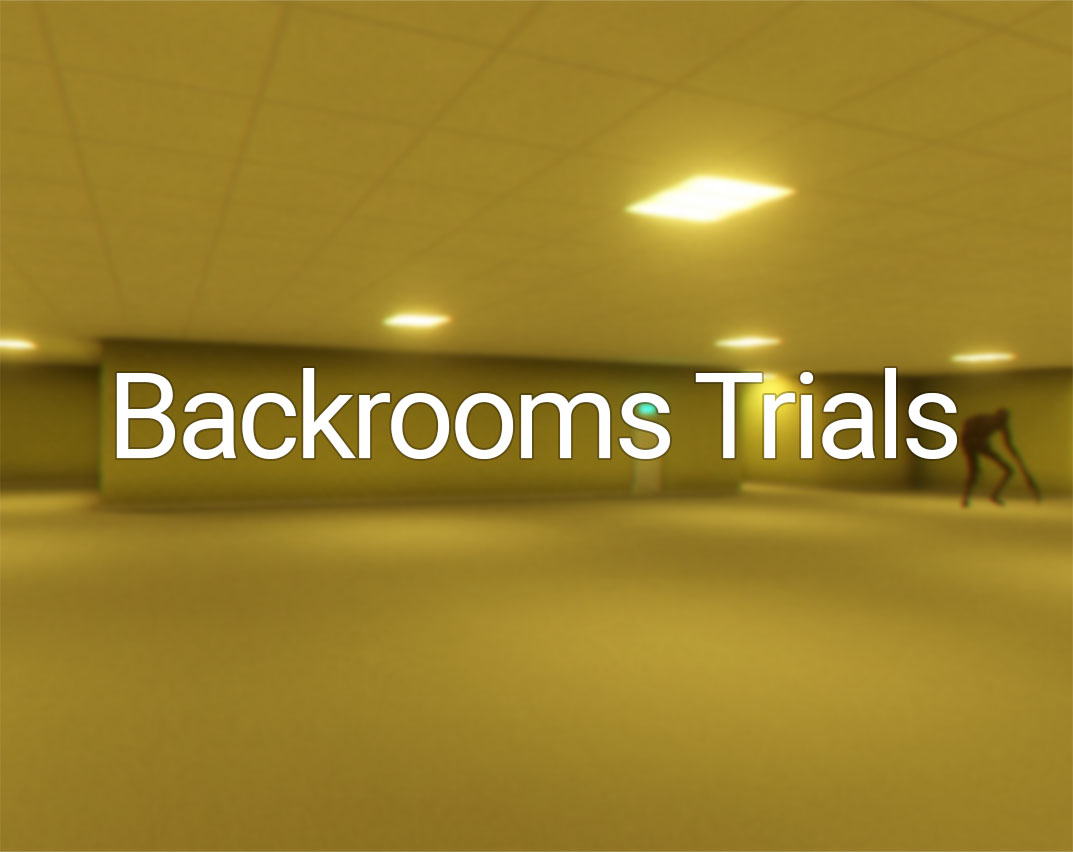
Backrooms Trials is a horror escape game set within the internet's most notorious liminal space — the Backrooms, an endless expanse of pale yellow rooms connected by damp carpeted corridors that stretch in every direction without logic or exit. You are locked inside. The only way out is keys. The keys are scattered somewhere across the rooms. The monster is already moving.
What makes Backrooms Trials an effective horror experience is its fidelity to the Backrooms mythology's specific psychological texture. The space itself is the primary source of dread — its silence, its sameness, its complete absence of anything that should be here. The rooms look identical. The carpet is the same everywhere. There are no windows, no landmarks, no clear sense of direction. The monster that shares the space with you is genuinely terrifying in its own right — faceless, impossibly tall, with a skin texture that wrong in a way that's hard to articulate — but it is the environment itself that the game's horror grows from.
Escape is mechanically simple in concept: find enough keys to open the exit door. In practice, the game's key distribution is deliberately challenging — no hints, no clues, no map markers. You walk the rooms until you find them, and the monster walks the rooms too, and the only warning you'll get before it sees you is whatever your own spatial awareness can construct from a maze that was designed to defy it.
Key Details
| Genre | Horror Escape |
| Difficulty Level | Medium / Hard |
| Average Play Time | 15–30 minutes per run |
| Best For | Backrooms lore fans, atmospheric horror players, and anyone who finds the specific dread of identical endless rooms more unsettling than any monster could be on its own |
How to Play Backrooms Trials
Getting Started
- Establish your movement approach immediately — the Backrooms' identical corridors make navigation genuinely disorienting. Before moving far from your starting position, make a deliberate attempt to identify any distinguishing features in your immediate area that can serve as a reference point.
- Begin searching rooms systematically — keys are placed at random positions with no hints about their location. The most reliable search approach is systematic room-by-room coverage rather than movement in any particular direction, which prevents retracing the same rooms repeatedly without finding anything.
- Listen constantly for the monster — the monster's approach is telegraphed by audio before visual contact occurs. Stop moving periodically to listen for sounds that don't belong to the ambient environment. Silence can be more concerning than sound in the Backrooms.
- Move continuously but not recklessly — staying stationary for extended periods while the monster is active is a risk. But running through unknown corridors without directional awareness creates its own danger. Find a pace that covers ground without sacrificing situational awareness.
- React immediately to warnings — the game provides a few warnings about nearby danger. These are finite and deliberately rare — treat each one as an immediate directive to change direction rather than an advisory to factor into ongoing movement.
Basic Controls
| Input | Action |
|---|---|
| WASD / Arrow Keys | Move through the rooms and corridors |
| Mouse | Look around / control camera direction |
| Sprint Key (Shift) | Run when monster is in pursuit |
| Key Collection | Automatic on contact with keys found in rooms |
| Danger Warnings (UI) | Heed immediately — indicates nearby monster |
Objective
Navigate the endless yellow rooms of the Backrooms, finding enough keys to unlock the exit door while evading the faceless, impossibly tall monster that moves through the same space. There are no hints about key locations — search every room you enter. Collect all required keys and reach the exit before the monster finds you.
Backrooms Trials Features & Highlights
- Authentic Backrooms atmosphere — the endless pale yellow rooms, identical carpeted corridors, and oppressive silence faithfully reproduce the specific existential dread of the internet's most famous liminal horror myth
- Randomized key placement — keys appear at different positions each run with no hints or clues about their locations, ensuring no two escape attempts follow the same path and memorization cannot replace active searching
- Genuinely unsettling monster design — a faceless, impossibly tall creature with disturbing skin texture that chases on sight, combining visual horror with the pursuit mechanic that makes standing still impossible
- Pure horror atmosphere — no weapons, no combat options, no tools beyond movement — the game's only mechanics are navigation, searching, and evasion, keeping the horror uncluttered by systems that might soften the tension
- Minimal UI horror design — a handful of danger warnings are the game's only concession to player assistance, maintaining the isolated, tool-less feeling of genuine Backrooms mythology
Backrooms Trials Tips & Strategies
Beginner Tips
- Treat every room as a potential key location, not just the ones that look different. The Backrooms' identical room design means there's no visual indication of which spaces contain keys. Players who try to identify "likely" rooms based on appearance miss keys in rooms that looked unremarkable. Search every accessible space without discrimination.
- Pay attention to the danger warnings when they appear. The game provides very few warnings about nearby monster presence. When one appears, don't continue in the same direction or stay in the same room — change course immediately. These warnings are the game's rare concession to player survival and should be treated as absolute directives.
- Build a mental map using movement patterns. Without a navigational aid, the Backrooms will disorient you. Establish a deliberate movement pattern — grid-based coverage, perimeter tracing, or another systematic approach — and stick to it. Any consistent pattern is more effective than undirected wandering, both for finding keys and for knowing which rooms you've already searched.
Advanced Strategies
- Use the monster's pursuit as directional information. When the monster sees you and gives chase, the direction it's coming from tells you something about where it's been. Running away from a pursuit through unsearched rooms while the monster follows from a known origin point effectively clears those rooms while putting distance between you — a two-purpose movement that experienced players use intentionally rather than accidentally.
- Sprint in straight lines during pursuit, turn only when necessary. The monster's speed during active pursuit is dangerous, and turns slow you down more than they slow the monster. When being chased, sprint as far as possible in the direction you're heading before turning rather than immediately zig-zagging. Distance created by sustained straight-line sprinting is generally more than distance recovered by turning away from the monster sooner.
What to Watch Out For
- Circular room coverage that revisits the same spaces. Without a systematic approach, it's easy to feel like you're covering ground while actually revisiting rooms you've already searched. If you've been moving for a long time without finding keys, assess whether your movement pattern has created a loop. Any consistent route through the Backrooms will tend to curve back toward areas already covered if direction isn't actively maintained.
- Complacency during quiet periods. The Backrooms are mostly silent, and extended periods without monster contact can reduce the alertness that the environment requires. The monster doesn't announce its proximity far in advance — the moment between first audio warning and visual contact can be brief. Maintain listening discipline even when everything seems clear.
Backrooms Trials Elements Explained
The Backrooms Environment
The Backrooms environment in Backrooms Trials is not a backdrop for the horror — it is the horror's primary instrument. The endless pale yellow rooms, the damp carpet that runs through every corridor and chamber, the fluorescent lighting that illuminates everything evenly and creates no shadows, the complete absence of windows, exits, or any indication of where here is in relation to anywhere else: these are not set dressing. They are the architecture of a specific psychological experience that the game is trying to produce.
The identical nature of the rooms is the environment's most actively disorienting quality and the one that creates the most practical survival difficulty. Navigation is the Backrooms' first obstacle, and it operates entirely through the player's spatial reasoning rather than any in-game assistance. There is no map, no minimap, no directional indicator. The rooms look the same because they are the same, and the game's horror is partly built on the helplessness of being unable to tell where you've been from where you haven't.
Key placement randomization compounds this. Even if spatial memory could be perfectly maintained across runs — unlikely in an environment designed to prevent it — the keys would be in different places every time. The Backrooms resists memorization as a survival strategy, which is entirely consistent with the mythology the game draws from.
Monster Behavior & Evasion
The monster in Backrooms Trials is designed to be visually arresting in its wrongness — faceless, impossibly tall, with a skin texture that the game describes as sticky in a way that makes proximity to it feel contaminating rather than merely dangerous. It moves through the same room network you're navigating, and the search for keys and the monster's patrol of the same space are constantly overlapping activities rather than separately staged challenge phases.
The monster's chase behavior activates on sight — as soon as it has a visual on your character, it pursues actively. This makes sightline management, rather than direct avoidance, the primary evasion skill. You cannot reliably know where the monster is at any given moment, but you can manage whether the rooms and corridors you're moving through give it an unobstructed view of your position. Moving along walls, around corners, and through rooms with multiple exit options are all habits that reduce the likelihood of the monster having a clear line of sight when you enter a new space.
When pursued, the monster is fast — running in straight lines covers more ground than turning, and turning in pursuit costs you more relative time than it costs the monster following your exact route. The most effective pursuit escape is not clever maneuvering but sustained, committed sprinting in whatever direction creates the most distance before a corner or room transition breaks the chase.
Key Collection & Exit System
Key collection is the game's mechanical objective and the purpose that the entire navigation and evasion system serves. Keys are placed randomly across the Backrooms' rooms at the start of each run, with no visual or audio indication of their proximity until you're close enough to collect them. Collection is automatic — entering a room with a key in it registers the collection without a specific interaction prompt.
The randomized placement means that key collection rate is a function of how systematically the available rooms are being searched rather than how efficiently specific routes are being navigated. A player who covers a large portion of the accessible room space in a reasonable time will find keys; a player who covers the same rooms repeatedly in search of something that isn't there will not. The distinction is navigational discipline — the willingness to commit to a coverage approach and maintain it even when the rooms all look the same.
The exit door requires a specific number of keys to open, which is visible in the game's minimal UI. The relationship between keys collected and keys required provides the only sense of progress the Backrooms offers — in an environment where distance covered is impossible to assess visually, watching the key count approach the required total is the one reliable measure of how close you are to getting out.
Backrooms Trials Frequently Asked Questions
Q: How do I find keys when there are no hints about where they are?
A: There are no hints — key finding is purely a function of room coverage. The most effective approach is to establish a consistent movement pattern that takes you through as many different rooms as possible without retracing, rather than moving in any specific direction or looking for visual cues that don't exist. If you've been searching for a long time without finding keys, you may be repeating rooms — try a different direction or a more structured coverage approach.
Q: What should I do when the monster sees me?
A: Run immediately and maintain your sprint in as straight a line as possible. Turns slow you down more than the monster, so commit to a direction and sprint until a room transition or corner provides cover that breaks the monster's sight line on you. Do not stop to search rooms during an active pursuit — cover as much ground as possible until the monster's audio cues indicate it has lost your position, then resume cautious movement.
Q: Is this game compatible with all browsers and devices?
A: Backrooms Trials is designed for modern desktop browsers, with best performance on Chrome or Firefox on an up-to-date desktop or laptop. The game uses keyboard and mouse controls — WASD for movement and mouse for camera control — making touchscreen and mobile devices unsuitable for the full navigation experience. Audio cues for monster proximity are important — headphones or quality speakers improve monster detection significantly.
Q: Can I save progress during a run?
A: Each run is a single session from start to escape or failure — there is no mid-run save system. If the monster reaches you before you've collected all required keys, the run resets from the beginning with randomized key placement. The short session length makes this appropriate to the format; each attempt is a fresh entry into the Backrooms rather than a continuation of a previous run.
Q: What do I do if I can't find the last key?
A: If most keys have been collected but the final one remains elusive, you've likely missed a room cluster in an area you haven't fully covered. Try moving in a consistently different direction from your established pattern — the Backrooms' identical appearance makes it easy to consistently avoid entire sections without realizing it. If the monster is actively hunting in the area you haven't covered, use the pursuit tactic: let it chase you through unsearched rooms, then resume systematic coverage once it loses your position.
Games Like Backrooms Trials You Might Enjoy
If you like Backrooms Trials, you might also enjoy:
- Saw 4 Trapped Online - it offers another tense escape route built around puzzles, danger, and careful exploration.
- Cabin Horror - it offers another tense escape route built around puzzles, danger, and careful exploration.
- Portrait of an Obsession a Forgotten Hill Tale - it offers another tense escape route built around puzzles, danger, and careful exploration.