

Five Nights at Freddy's: NES Overview
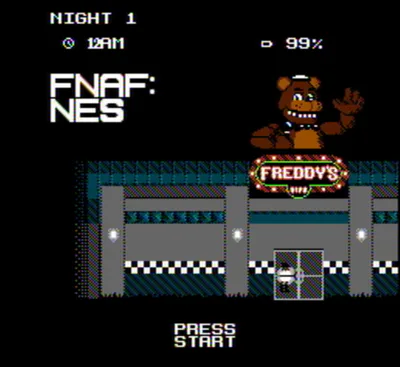
Before high-resolution cameras and detailed shadow rendering, horror games worked with what they had — and what 8-bit hardware had was enough. Five Nights at Freddy's: NES reimagines the original survival horror formula through the aesthetic of a classic NES-era game: pixel art graphics, chiptune sound effects, and the particular kind of dread that comes from a world rendered in a limited color palette where your imagination fills in the rest.
The mechanics are faithful to the source material. You are the night security guard at a haunted pizzeria. Freddy, Bonnie, Chica, and Foxy move through the building after midnight. You track them through a camera system, check hallways with lights, close doors when they get close, and manage a power supply that will not last until morning if you use it carelessly. The rules haven't changed. What's changed is the presentation — and the retro aesthetic creates its own specific atmosphere, one that nods to the era of games where limited graphics forced tension to come from sound design, imagination, and the knowledge that something was moving toward you even if the pixels couldn't quite render what it looked like.
There's also something genuinely effective about seeing Freddy Fazbear in 8-bit. The chunky sprites carry a different kind of uncanny quality than photorealistic renders — something about the simplicity makes the threat feel more elemental. Five Nights at Freddy's: NES is for players who want the classic survival challenge wrapped in the visual language of the era that defined game horror before game horror knew what it was.
Key Details
- Genre: Survival Horror / Strategy
- Difficulty Level: Variable (same escalating pressure as the original across five nights)
- Average Play Time: 10–20 minutes per night attempt
- Best For: FNaF fans who appreciate retro aesthetics, players nostalgic for 8-bit presentation, and anyone who wants the classic survival formula with a different visual identity
How to Play Five Nights at Freddy's: NES
Getting Started
1. Open the security camera system at the start of your shift and locate each animatronic — Freddy, Bonnie, Chica, and Foxy each begin in specific areas of the pizzeria. 2. Cycle through camera feeds regularly in a consistent rotation, watching for animatronics that have moved from their starting positions. 3. Use the hallway lights outside each door to check the corridors adjacent to your office — these blind spots cannot be covered by cameras. 4. Close the door immediately when you confirm an animatronic in the adjacent hallway, then reopen as soon as it has moved to conserve power. 5. Survive until the clock reaches 6:00 AM to complete the night.
Basic Controls
- Mouse: Interact with all office systems — navigate camera feeds, activate lights, and operate doors
- Click: Switch between camera views and activate defensive tools
Objective: Track the animatronics through the 8-bit camera system, use hallway lights to check blind spots, and close doors to prevent animatronic entry. Manage the power supply carefully to keep all systems running until 6:00 AM.
Five Nights at Freddy's: NES Features & Highlights
- Retro 8-bit art style — pixel graphics and chiptune audio recreate the visual and sonic language of classic NES-era games within the FNaF horror framework
- Classic four-animatronic cast — Freddy, Bonnie, Chica, and Foxy rendered in pixel art, each retaining their distinct behavioral patterns from the original formula
- Faithful survival mechanics — camera monitoring, hallway lights, security doors, and power management all operate identically to the original FNaF formula
- Escalating nightly difficulty — animatronics become faster and more aggressive across five nights, maintaining the pressure curve of the source material
- Jumpscare moments in pixel art — the game's surprise attack sequences land differently in 8-bit presentation — in some ways more unsettling for their simplicity
Five Nights at Freddy's: NES Tips & Strategies
Beginner Tips
- Learn the camera layout on Night 1. The 8-bit camera feeds cover the same areas as the original game — identify which pixel-art room corresponds to which section of the pizzeria before the animatronics become genuinely threatening.
- Check Pirate Cove (Foxy's camera) in every rotation sweep. Foxy's advancement mechanic operates identically to the original — neglecting that specific camera causes him to sprint to your left door regardless of where the other animatronics are.
- Close doors only after confirming a threat with the hallway light. The power cost of unnecessary door closures is the most common cause of running out of electricity before 6:00 AM — use the light to verify before spending power on a door closure.
Advanced Strategies
- Learn each animatronic's pixel-art tells. In the 8-bit presentation, animatronic position within a camera frame may look slightly different than in the original — spending a few nights identifying which sprite positions indicate close approach versus distant presence pays off significantly on harder nights.
- Develop a power budget by night. The electricity meter depletes at a consistent rate — understanding roughly how much power each hour costs at your typical usage rate lets you identify when you're running ahead or behind your sustainable pace.
- On Night 5, apply a strict low-power protocol: reduce camera sweep frequency, rely more on hallway lights for close-range detection, and never hold doors shut any longer than necessary. The same principles apply regardless of the visual presentation.
What to Watch Out For
- Don't let the retro aesthetic obscure threat signals. The pixel art camera feeds and chiptune audio cues carry the same information as the original game — animatronic position, proximity, and movement are all communicated through the 8-bit visual language, and learning to read it is as important as in any other version.
- Don't underestimate the jumpscare impact. 8-bit jumpscares hit differently than photorealistic ones, but the surprise still lands — especially when power has just run out and you're not expecting Freddy's pixel sprite to fill the screen.
Five Nights at Freddy's: NES Elements Explained
8-Bit Visual Design: The defining characteristic of Five Nights at Freddy's: NES is its commitment to the retro aesthetic. Character sprites, environments, camera feeds, and the security office are all rendered in pixel art within a limited color palette consistent with NES-era game design. The effect is not merely cosmetic — 8-bit presentation changes how the horror is perceived. Details that high-resolution rendering makes explicit are left to suggestion in pixel art: the texture of an animatronic suit, the specific expression of a face, the precise state of a hallway. The player's imagination completes what the graphics leave open, which is historically how 8-bit horror games generated tension effectively. The chiptune audio design carries an equivalent amount of atmospheric weight — the low-fidelity sound effects for animatronic movement, camera switching, and jumpscares create a different sensory register than modern audio while maintaining the information value those sounds carry.
Power Management System: The electricity meter operates identically to the original FNaF formula regardless of the visual presentation. A finite power supply depletes throughout the night at a baseline rate, accelerated by every active system — camera monitor, hallway lights, and security doors. Doors remain the most expensive individual action, making them last-resort tools rather than precautionary ones. If power reaches zero before 6:00 AM, all defensive systems fail simultaneously and the animatronics can access the office without obstruction. The 8-bit power indicator may display slightly differently than modern versions but communicates the same critical information — monitoring it continuously throughout each night is as essential in this version as in any other.
Animatronic Behaviors in Pixel Form: Freddy, Bonnie, Chica, and Foxy retain their original behavioral patterns within the 8-bit presentation. Bonnie is typically the first to become active, approaching from the left hallway. Chica moves through the right side via the dining area. Foxy responds to camera-check frequency on Pirate Cove, advancing through visible pixel-art stages toward a sprint attack when that camera is neglected. Freddy is the most patient, building aggression across the night and becoming the most dangerous threat in the later hours. Learning to read these behaviors through the pixel-art camera feeds — identifying which sprite position in which feed indicates which stage of approach — is the primary skill adaptation required by the NES format.
Five Nights at Freddy's: NES Frequently Asked Questions
Q: Is the gameplay identical to the original FNaF?
A: Yes — the survival mechanics are faithful to the original formula. Camera monitoring, hallway lights, security doors, power management, and the five-night difficulty escalation all operate identically. The difference is entirely in the visual and audio presentation.
Q: How do I tell where animatronics are on the 8-bit camera feeds?
A: Each camera feed shows a pixel-art rendering of a specific area of the pizzeria. Animatronic sprites visible in a feed indicate their current position. Learning which sprite positions indicate close approach versus distant presence takes a few nights of observation — pay attention to which camera feeds precede a hallway appearance on early nights to build that spatial understanding.
Q: Why does Foxy keep attacking me?
A: Foxy's advancement is tied specifically to how often you check the Pirate Cove camera — not general camera monitoring. Include that specific feed in every rotation cycle. Once he begins his sprint (visible on the hallway camera), close the left door immediately.
Q: Can I save my progress?
A: Completed nights are saved automatically upon surviving to 6:00 AM. Each successful night records your progress and unlocks the following night for your next session.
Q: Does the 8-bit version have the same nights and animatronics as the original?
A: Yes — the NES version covers the same five-night structure with the same animatronic cast (Freddy, Bonnie, Chica, and Foxy) and the same escalating difficulty curve as the original game.
Games Like Five Nights at Freddy's: NES You Might Enjoy
If you like Five Nights at Freddy's: NES, you might also enjoy:
- Five Nights at Freddy's - it shares the same animatronic pressure, survival timing, and quick browser play rhythm.
- Five Nights at Freddy's 2 - it shares the same animatronic pressure, survival timing, and quick browser play rhythm.
- Five Nights at Freddy's 3 - it shares the same animatronic pressure, survival timing, and quick browser play rhythm.