
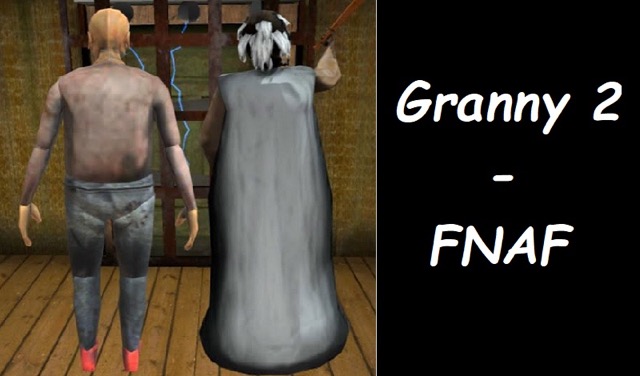







Granny 2 - FNAF Overview
You wake up inside a house you don't recognize. The floors creak with every step. The rooms are dark and cluttered. Somewhere in the building, Granny is moving — and she will hear you before she sees you. Granny 2 - FNAF takes the premise of the classic Granny survival horror game and layers it with a camera-monitoring mechanic drawn from the Five Nights at Freddy's universe, creating a hybrid experience where stealth and surveillance work together as your primary survival tools.
The goal is escape. The building has multiple exits, but none are accessible without first working through the environment — finding objects, solving the conditions for each locked door, navigating spaces Granny regularly patrols. What makes Granny 2 - FNAF distinct is the camera system. As you explore, you find deactivated surveillance cameras scattered through the house. Installing them in key locations builds you a monitoring network — and once they're active, you can switch between feeds to track Granny's position before committing to movement through any given corridor.
This is not a game that rewards speed. The floors creak. Dropping an object makes noise. Running is a last resort, not a default movement state. The player who survives longest in Granny 2 - FNAF is the one who moves deliberately, uses the camera network wisely, and hides before Granny's patrol route brings her to a space they're already in. The combination of active surveillance building and careful stealth navigation creates a tension specific to this hybrid — the anxiety of a game where you're building your own early warning system while trying not to make enough noise to need it.
Key Details
- Genre: Survival Horror / Stealth / Escape
- Difficulty Level: Hard (Granny's detection sensitivity and instant-failure consequences demand consistent discipline)
- Average Play Time: 20–40 minutes per attempt
- Best For: Fans of stealth-based escape horror, players who enjoy the Granny game format, and FNaF players who want camera-building mechanics in a first-person stealth environment
How to Play Granny 2 - FNAF
Getting Started
1. Begin by exploring the immediate starting area carefully — identify any cameras within reach and any objects that can be collected without generating noise. 2. Install cameras in high-traffic areas (hallways, stairwells, the paths between key rooms) to begin building your surveillance network. 3. Once cameras are active, switch between feeds to check Granny's current position before moving through connected spaces. 4. Move slowly through the house — avoid running, avoid dropping objects, and step around areas of the floor that creak under movement. 5. Work progressively toward the exit by finding the required items and solving each locked access point.
Basic Controls
- Arrow Keys / WASD: Move through the house
- Mouse: Look around, observe the environment, and aim interactions
- E Key: Interact with objects, collect cameras, and install them in designated locations
Objective: Escape Granny's house by finding the required items and unlocking the exit, all while tracking Granny's movements through your installed camera network and hiding whenever she approaches your position.
Granny 2 - FNAF Features & Highlights
- Player-built camera network — collect and install surveillance cameras to create your own monitoring system rather than accessing a pre-existing feed
- Stealth-first movement — noise-sensitive detection design rewards slow, deliberate navigation and punishes any action that generates sound
- Hybrid Granny and FNaF mechanics — escape-game structure layered with camera-surveillance gameplay creates a distinct format not fully represented by either source
- Instant-fail consequence design — discovery by Granny ends the attempt immediately, giving every decision genuine weight and consequence
- Dynamic patrol routes — Granny's unpredictable movement through the house prevents the kind of pattern memorization that makes other stealth games feel mechanical
Granny 2 - FNAF Tips & Strategies
Beginner Tips
- Install your first camera in a hallway rather than a room. Hallways carry Granny between the areas you need to search — a camera covering a key hallway gives you advance warning about her direction of movement before she arrives at any destination.
- Hide under the bed or inside closets the moment you hear Granny approaching an area you're currently in. Don't wait for visual confirmation — the audio cue of her footsteps getting louder is the signal to stop everything and conceal yourself immediately.
- Never drop objects on hard floors. The noise generated by a dropped item attracts Granny from a significant distance — carry objects carefully and set them down deliberately rather than releasing them mid-movement.
Advanced Strategies
- Build your camera network methodically, prioritizing coverage of the paths between areas you need to visit repeatedly. A camera in a room you only visit once has less ongoing value than one covering the corridor you pass through on every trip between floors.
- Use the camera feeds to time your movements between Granny's patrol cycles rather than moving and hoping she isn't in your path. Watching where Granny is heading on camera, waiting for her to commit to a direction away from your destination, then moving quickly to your target — and stopping the moment her direction changes — is consistently more reliable than stealth movement without surveillance support.
- Identify and memorize the location of all creaking floor sections early in each attempt. These are fixed positions — the same boards creak in the same spots every run. Routing around them rather than stepping on them and stopping eliminates a major source of noise generation during movement.
What to Watch Out For
- Don't assume a quiet house means Granny is far away. Her patrol is unpredictable enough that extended silence doesn't reliably indicate distance. Always check camera feeds before committing to movement through a new area, regardless of how quiet the house currently feels.
- Don't rush toward the exit before all required items are collected and the access conditions are met. The house's exit system requires specific items and unlocked conditions — moving toward a locked door without the means to open it places you in an exposed position without progress to show for the risk.
Granny 2 - FNAF Elements Explained
Camera Collection and Installation: Unlike standard FNaF games where a pre-existing camera network is available from the start, Granny 2 - FNAF requires you to build your surveillance system from scratch. Deactivated cameras are placed throughout the house as collectible objects. Retrieving each camera and installing it in an appropriate location — typically a wall-mounted position in a hallway or key area — adds that feed to your monitoring network. This design makes the camera system a progression mechanic as well as a survival tool: early attempts operate with limited surveillance coverage and high uncertainty about Granny's position, while a well-constructed network provides comprehensive coverage of the house's main routes and dramatically improves your ability to move safely. Deciding which locations get cameras — given that you may not find enough for full coverage — is a meaningful strategic choice that shapes the entire attempt.
Granny's Detection System: Granny moves through the house on a patrol that is unpredictable enough that memorization alone is insufficient for consistent survival. Her detection operates primarily through sound: movement generates noise based on pace and surface, dropped objects create sharp audio spikes that attract immediate attention, and running is audible from a significant distance. Visual detection is secondary — Granny responds to movement she can see directly, but her primary threat vector is audio. This design means that the most reliable survival behavior is movement discipline: walking at a slow pace across surfaces that don't creak, handling objects carefully, and stopping completely when her patrol route brings her close. The instant-fail consequence of detection reinforces this discipline — there is no tolerance for careless noise in a house where one mistake ends the attempt.
Escape Structure and Item Progression: The house's exit is locked behind a series of conditions that require finding specific items and using them on the correct access points throughout the building. Keys unlock doors. Objects in one area enable access to another. The progression is non-linear enough that different attempts may approach the required items in different orders depending on which areas are safely accessible given Granny's current patrol position. The camera network's value within this structure is significant: knowing where Granny is at any given moment determines which parts of the house are safely explorable and which are too dangerous to approach, making surveillance information directly relevant to moment-by-moment navigation decisions throughout the full attempt.
Granny 2 - FNAF Frequently Asked Questions
Q: How do I install the cameras I find?
A: Pick up each camera using the E key when you're near it. When you find a suitable installation spot — typically a wall mount in a hallway or key area — interact with the mount using E to install the camera. Once installed, it becomes accessible through your camera monitoring feed.
Q: What should I do if Granny catches me in a room?
A: If you hear her approaching and haven't been spotted yet, immediately hide under the nearest bed or inside a closet using the E key. Stay completely still until her footsteps indicate she has moved away from your position. If she has already spotted you, the attempt ends — there is no recovery from direct detection.
Q: How many cameras can I install?
A: The number of available cameras in each attempt is limited by how many you find while exploring. Prioritize installing cameras in hallways and high-traffic areas before rooms you'll only visit once, to maximize the ongoing surveillance value of each camera you place.
Q: Is there a fixed escape route or does it change between attempts?
A: The house layout and required items are consistent between attempts — the same items are needed in the same locations to unlock each access point. Granny's patrol pattern varies more significantly, which means the same escape route may be safely accessible in one attempt and actively patrolled in another.
Q: Can I save my progress mid-attempt?
A: Granny 2 - FNAF does not save mid-attempt progress. Detection by Granny restarts the current attempt from the beginning. The house layout remains consistent between attempts, so knowledge and spatial familiarity carry forward even when individual attempts reset.
Games Like Granny 2 - FNAF You Might Enjoy
If you like Granny 2 - FNAF, you might also enjoy:
- Five Nights at Freddy's 2 - it shares the same animatronic pressure, survival timing, and quick browser play rhythm.
- FNAF Shooter - it shares the same animatronic pressure, survival timing, and quick browser play rhythm.
- FNAF Strike - it shares the same animatronic pressure, survival timing, and quick browser play rhythm.